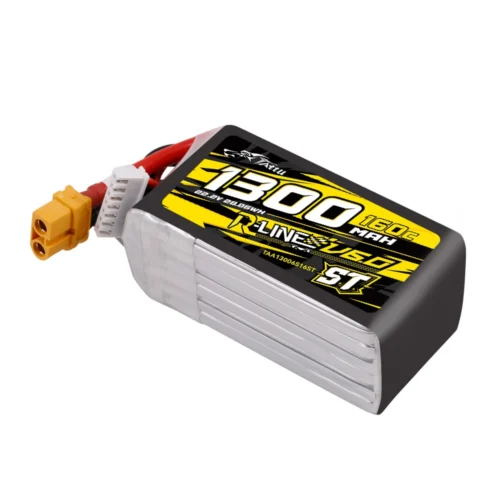
Tattu R-Line 4S 850mAh 150C Battery (XT30) – High-Performance LiPo Battery for FPV Drones
Tattu R-Line 4S 850mAh 150C Battery (XT30) is a high-performance lithium polymer battery designed for demanding FPV drone pilots who require rapid throttle response, stable power delivery and high current output. The R-Line series combines a high discharge rate, compact construction and low internal resistance, providing a suitable power solution for both competitive racing and freestyle flying.
The battery features a capacity of 850mAh, a nominal voltage of 14.8V and a 150C discharge rate. Its 4S1P configuration, consisting of four cells connected in series, delivers the power required by FPV drone motors during intensive manoeuvres. Equipped with an XT30 power connector, the battery is primarily suitable for compact FPV drones whose electrical systems support 4S batteries.
Tattu R-Line 4S is a practical choice for pilots who value battery performance, reliable power delivery and an optimal balance between weight and power.
R-Line Series – Designed for Demanding FPV Flying
The Tattu R-Line battery series has been developed specifically for high-performance FPV drones, where battery characteristics directly influence flight speed, acceleration and control precision.
During competitive racing and freestyle flying, motor power requirements can change extremely quickly. Sudden acceleration, turns, climbs and other dynamic manoeuvres require a battery capable of delivering high current within a short period.
The Tattu R-Line 4S 850mAh 150C battery is designed to handle these demanding loads, offering high-discharge power delivery and reduced internal resistance.
R-Line Version 5.0 technology aims to improve power output and reduce voltage drop under load. This helps maintain a more consistent flying experience even when the motors suddenly require additional energy.
The battery is suitable for pilots seeking precise drone response and consistent performance throughout their flights.
850mAh Capacity – A Balance Between Weight and Energy Reserve
The Tattu R-Line 4S battery has a capacity of 850mAh, equivalent to 0.85Ah, providing a suitable energy reserve for compact FPV drones.
Battery capacity indicates how much electrical charge can be stored. A higher-capacity battery may provide longer flight times but is generally heavier. A lower-capacity battery helps reduce the drone’s overall weight but offers a more limited energy reserve.
The 850mAh capacity represents a compromise particularly suitable for compact and lightweight FPV drones where maintaining good manoeuvrability is essential.
The battery’s nominal energy is approximately 12.58Wh, calculated by multiplying its 14.8V nominal voltage by its 0.85Ah capacity.
This energy reserve supports intensive flights, although actual flight time depends on the motors, propellers, drone weight, flying style and weather conditions.
For example, energy consumption may be lower during relaxed flying than during aggressive freestyle sessions or racing, where high throttle input is frequently required.
4S Configuration and 14.8V Nominal Voltage
Tattu R-Line 4S uses four lithium polymer cells connected in series, forming a 4S1P configuration.
A standard LiPo cell has a nominal voltage of 3.7V. Connecting four cells in series provides a total nominal battery voltage of 14.8V.
A fully charged standard 4S LiPo battery reaches 16.8V, as the maximum charging voltage of each cell is 4.2V.
This configuration is suitable for FPV drones whose electronics, motors and electronic speed controllers are designed for 4S power systems.
The 14.8V nominal voltage enables sufficient power delivery to the motors and supports rapid response to throttle changes.
Before using the battery, it is essential to check the drone electronics’ permitted input voltage. Using a 4S battery may be unsafe if the drone is designed exclusively for 2S or 3S batteries.
150C Discharge Rate for High-Current Applications
One of the most important characteristics of the Tattu R-Line 4S 850mAh battery is its 150C discharge rate.
The C rating expresses the battery’s discharge capability relative to its capacity. The higher the C rating, the greater the current the battery is rated by the manufacturer to deliver.
Based on its 850mAh or 0.85Ah capacity and 150C discharge rating, the battery’s theoretical rated discharge current is 127.5A.
This is a calculated figure based on the manufacturer’s stated C rating. Actual usable current depends on battery temperature, state of charge, wiring and connector limitations, and other operating conditions.
The advantage of a high discharge capability becomes particularly apparent when the drone’s motors require substantial power over a short period.
For example, a steep climb, rapid acceleration or aggressive manoeuvre can cause energy demand to increase almost instantly.
The 150C discharge rating helps provide the current reserve needed for such situations.
Low Internal Resistance and More Stable Voltage Output
For high-performance FPV batteries, internal resistance is just as important as capacity.
Internal resistance affects how much voltage drops when the load increases and how much energy is dissipated as heat within the battery.
Tattu R-Line 4S belongs to the R-Line series, which has been developed with particular attention to low internal resistance and high current output.
Lower internal resistance helps reduce voltage sag during heavy loads.
This is especially important for FPV racing drones, where sudden throttle increases can generate substantial instantaneous demand.
More stable voltage output helps maintain consistent motor operation and supports precise drone control.
Actual battery performance nevertheless depends on its condition, temperature, state of charge and usage history.
R-Line Version 5.0 and Al Boehmite Technology
The Tattu R-Line 4S 850mAh 150C battery is available as an R-Line Version 5.0 model developed using the manufacturer’s Al Boehmite technology.
This technology aims to improve power delivery stability, reduce internal resistance and support performance retention over repeated charging and discharging cycles.
The manufacturer describes the Version 5.0 series as a solution aimed at demanding FPV racing pilots and freestyle flyers.
Higher power reserves help the drone respond more quickly to sudden throttle changes, while more consistent voltage output supports a more controlled flying experience.
Battery lifespan and performance retention still depend on operating conditions. Excessive heat, deep discharge and improper charging can shorten battery life.
XT30 Power Connector – Compact Connection for FPV Drones
The Tattu R-Line 4S 850mAh 150C battery is equipped with an XT30 power connector, commonly used in smaller FPV drones and other compact radio-controlled devices.
The XT30 connector provides a compact connection solution that helps keep wiring and connector dimensions relatively small.
This is important for lightweight FPV drones, where every additional gram can influence flight characteristics.
The battery’s XT30 connector allows it to connect to a compatible counterpart in the drone’s electrical system.
When selecting a connector, the drone’s actual current consumption must also be considered. Although the discharge current calculated from the battery’s C rating is high, this does not automatically mean that the XT30 connector is suitable for carrying the same continuous current.
Therefore, the permitted loads of the battery, connector, wiring and drone electrical system must all be respected.
Before use, check the connection polarity and ensure the connectors are clean and undamaged.
Balance Connector for Proper Battery Charging
In addition to the XT30 main power connector, Tattu R-Line 4S features a balance connector typical of multi-cell LiPo batteries.
The R-Line Version 5.0 850mAh 4S model uses a JST-XHR-type balance connector, allowing a compatible charger to monitor individual cell voltages.
When charging a four-cell battery, it is important that all cells reach the appropriate state of charge without exceeding their permitted voltage limits.
Balance charging helps reduce voltage differences between cells and supports safe battery operation.
A dedicated LiPo charger supporting the 4S configuration must be used.
The charger must be set to the correct battery chemistry, cell count and charging current.
Compact Construction and Approximately 100-Gram Weight
Tattu R-Line 4S 850mAh 150C is designed for compact FPV drones where battery dimensions and weight directly influence the drone’s balance.
The R-Line Version 5.0 850mAh 4S model weighs approximately 100 grams and measures around 59 × 30 × 32 mm. Dimensions may vary slightly depending on the measurement method and production batch.
This construction is suitable for smaller drones with battery trays and mounting systems designed for a battery of the corresponding size.
Battery weight influences the drone’s overall mass, centre of gravity and flight characteristics.
An excessively heavy battery may reduce manoeuvrability, while a battery with insufficient energy capacity may limit flight time.
It is therefore important to select a battery that matches the drone’s specific construction and intended flying style.
Suitable for Racing and Freestyle FPV Drones
Tattu R-Line 4S 850mAh 150C is primarily suitable for compact FPV drones where high power and rapid response are important.
The manufacturer positions the R-Line Version 5.0 850mAh 4S model for use with approximately 3–5-inch FPV drones, although actual compatibility depends on drone weight, motors, electronics and battery mounting dimensions.
The battery may be suitable for racing drones where rapid acceleration and precise control are priorities.
It is also practical for freestyle flying involving sharp turns, climbs, dives and other dynamic manoeuvres.
The compact battery may also suit smaller cinewhoop-type drones if their electrical systems support 4S power and the battery dimensions fit the frame.
How the Battery Affects Drone Flight Characteristics
Choosing an FPV drone battery influences more than flight time alone.
The Tattu R-Line 4S 850mAh 150C battery combines relatively low weight with high discharge capability, potentially helping maintain good acceleration and manoeuvrability.
Using a lighter battery can reduce the drone’s overall mass, influencing how it responds to control inputs.
However, a smaller energy reserve may result in shorter flight times compared with higher-capacity batteries.
Battery suitability therefore depends on pilot preferences and intended use.
In racing, rapid response and low weight may be the main priorities, whereas longer flight time may be more important during relaxed flying.
The 850mAh capacity and 150C discharge rating make this battery a suitable option when performance and compact construction are preferred.
LiPo Battery Charging and Safe Use
Tattu R-Line 4S uses lithium polymer, or LiPo, technology, enabling high energy density and high discharge capability.
However, proper safety precautions must be followed when using LiPo batteries.
The battery must only be charged using a compatible LiPo charger that supports 4S batteries and balance charging.
The maximum charging voltage of a standard LiPo cell is 4.2V, meaning a fully charged 4S battery reaches 16.8V.
Never leave the battery unattended while charging. A fire-resistant charging bag or another suitable fire-safe charging location is recommended.
The charging current must be selected according to the manufacturer’s instructions. At a 1C charging rate, an 850mAh battery would be charged at 0.85A.
Do not charge the battery if it is swollen, damaged, unusually hot or if its wires and connectors show visible damage.
Short circuits and mechanical damage must also be avoided.
Battery Storage and Lifespan Preservation
Proper storage is important for maintaining the long-term reliability of the Tattu R-Line 4S battery.
If the battery will not be used for an extended period, it should be brought to an appropriate LiPo storage voltage.
A typical LiPo storage voltage is approximately 3.8–3.85V per cell, corresponding to around 15.2–15.4V for a 4S battery.
Store the battery in a cool, dry location protected from direct sunlight and excessive heat.
The battery should not be left fully charged or deeply discharged for extended periods.
After an intensive flight, allow the battery to cool before charging.
Regularly checking individual cell voltages helps identify potential irregularities and assess the battery’s overall condition.
Proper maintenance helps reduce premature deterioration and preserve performance.