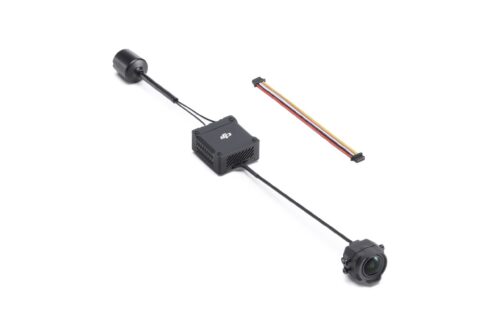
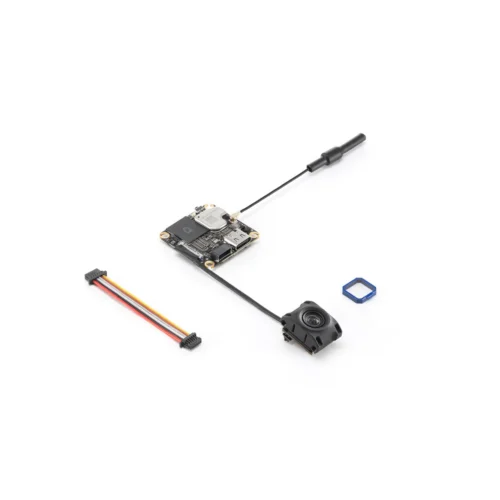
DJI O4 Wide Air Unit – Digital Video Transmission System with a 159° FOV for FPV Drones
DJI O4 Wide Air Unit is a compact camera and video transmission solution that brings DJI O4 digital video transmission, high-quality 4K recording, and an ultra-wide 159° field of view to a custom-built FPV drone. It is an upgraded version of DJI O4 Air Unit, with its main advantage being a wider and more immersive flight perspective. The wider image provides a better view of the drone’s surroundings and gives freestyle footage a more dynamic visual character.
DJI O4 Wide Air Unit is suitable for both pilots new to FPV and experienced freestyle flyers looking to combine low weight, low video transmission latency, and a wider-than-standard field of view. The system integrates a camera module, digital O4 video transmission, and internal video recording, reducing the need to add a separate action camera to the drone for high-quality aerial footage.
159° Field of View for Immersive FPV Flying
The main difference between DJI O4 Wide Air Unit and the standard O4 Air Unit is its ultra-wide-angle lens with a 159° field of view. The wide perspective shows the pilot more of the drone’s surroundings and improves spatial awareness during fast turns, flights through narrow gaps, and technical freestyle routes. It also captures more of the environment, helping make flight footage more immersive for viewers.
The lens has a 35mm-equivalent focal length of 16mm and an f/2.8 aperture. Its focus range extends from one metre to infinity, making the system particularly well suited to the medium and longer shooting distances typical of FPV flying. Standard and wide-angle fields of view are available, allowing the image to be adjusted according to the flying style and desired visual result.
1/2-Inch CMOS Sensor and 4K/60fps Recording
DJI O4 Wide Air Unit uses a 1/2-inch CMOS image sensor capable of capturing detailed 4K video at up to 60 frames per second. In 4K, footage can be recorded in a 4:3 aspect ratio at 3840 × 2880 or in a conventional 16:9 format at 3840 × 2160. Frame rates of 30, 50, and 60fps are available in both formats.
Higher frame rates can be used at Full HD 1080p resolution. The system supports up to 120fps in both 4:3 and 16:9 formats, providing greater flexibility for capturing fast movement smoothly and creating slow-motion sequences. Videos are recorded in MP4 format, with a maximum video bitrate of 100Mbps.
In automatic mode, the camera offers an ISO sensitivity range of 100–6400, while manual adjustment extends the range to ISO 100–12,800. This allows exposure to be adapted to different lighting conditions, although well-lit environments are recommended for the best possible image quality.
RockSteady 3.0+ Stabilisation and Gyroflow Support
Built-in RockSteady 3.0+ electronic image stabilisation helps reduce video shake caused by drone vibration, rapid changes of direction, and abrupt manoeuvres. Stabilised footage is ready to use with minimal post-production, making it easier to produce smooth and polished flight videos.
For pilots who prefer to stabilise footage later on a computer, electronic stabilisation can be disabled and the recorded gyroscope data used with Gyroflow software. This provides greater control over stabilisation strength, image cropping, and the overall character of movement. When RockSteady is enabled, only the standard field of view is available, so the ultra-wide perspective and in-camera stabilisation should be selected according to the desired result.
Low-Latency DJI O4 Video Transmission
DJI O4 Wide Air Unit transmits a live feed to compatible DJI goggles at up to 1080p/100fps. The high frame rate provides a smooth image and precise control, which is particularly valuable during fast manoeuvres, freestyle flying, and racing practice. Maximum video transmission bandwidth is 60MHz, and the system uses a single 1T1R antenna.
When used with DJI Goggles 3 in Racing mode, video transmission latency can be as low as 20ms. Minimum latency is 24ms with DJI Goggles N3 and up to 35ms with DJI Goggles 2 or Goggles Integra. These values were measured in an open, interference-free environment, and actual latency depends on the equipment, radio-frequency conditions, and other factors affecting the flight.
Under the CE standard used in Europe, maximum video transmission range can reach up to six kilometres when DJI Goggles 3 or Goggles N3 are used. This result was measured outdoors in an unobstructed and interference-free environment. Actual operating range depends on the drone configuration, battery endurance, surroundings, and local regulations. Pilots must always comply with applicable flight rules and maintain safe control of the aircraft.
Racing Mode for Fast and Responsive Control
Racing mode on the DJI O4 Air Unit Series sets both recording and video transmission to 1080p/100fps and switches channel selection to manual mode. This allows the use of 20 or 40MHz bandwidth and helps minimise latency when fast response is more important than maximum recording resolution.
DJI Goggles 3 or DJI Goggles N3 are required to use Racing mode. The system is also compatible with the Race Band channel allocation used by analogue video transmission systems, making it practical on tracks or at locations where FPV drones with digital and analogue video transmission are flown simultaneously.
23GB of Internal Storage without a microSD Card
DJI O4 Wide Air Unit includes 23GB of internal storage for videos recorded during flight. A separate microSD card is not required, and the system does not support external memory cards. Integrated storage helps keep the construction compact and reduces the number of components that need to be added to the drone.
Available storage space should be checked before each flying session, particularly when using 4K resolution and high frame rates. After transferring recordings to a computer, unnecessary files can be removed from the internal storage to make room for future flights.
Low Weight and Compact Construction
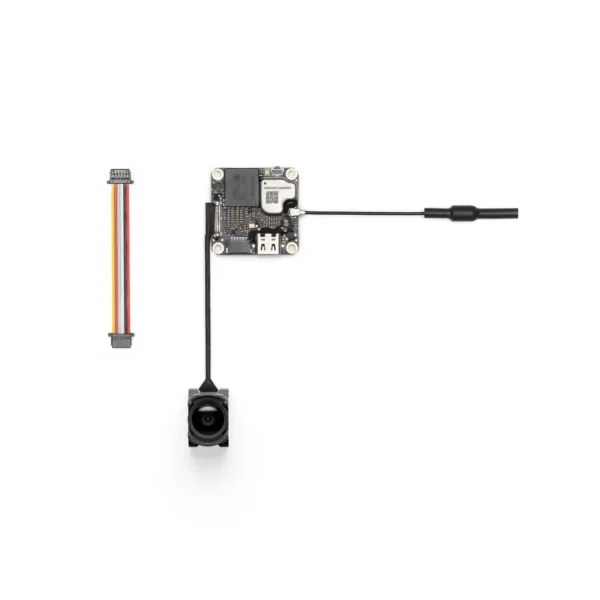
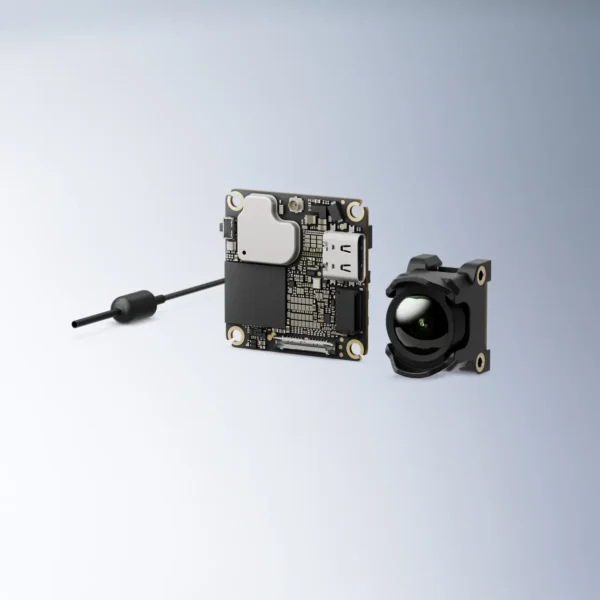
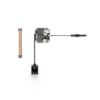
The video transmission module of DJI O4 Wide Air Unit weighs approximately 5.1 grams without the camera module and around 13.3 grams with the camera module installed. The antenna weighs approximately 0.75 grams. This low weight helps preserve a favourable power-to-weight ratio and adds less load to the aircraft than a separate action camera.
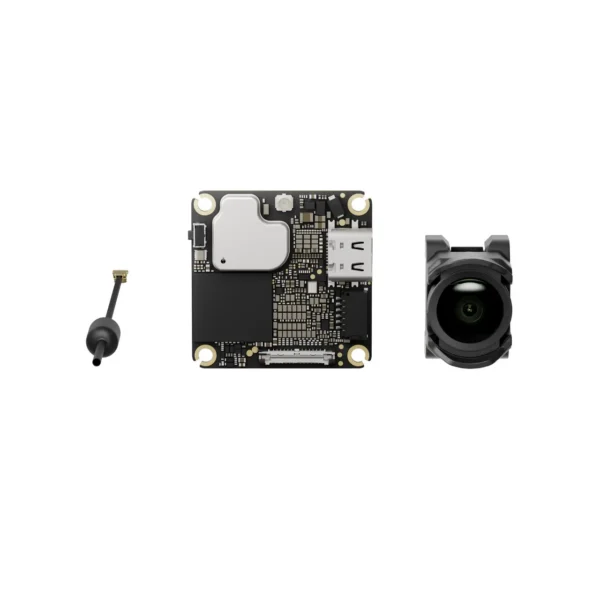
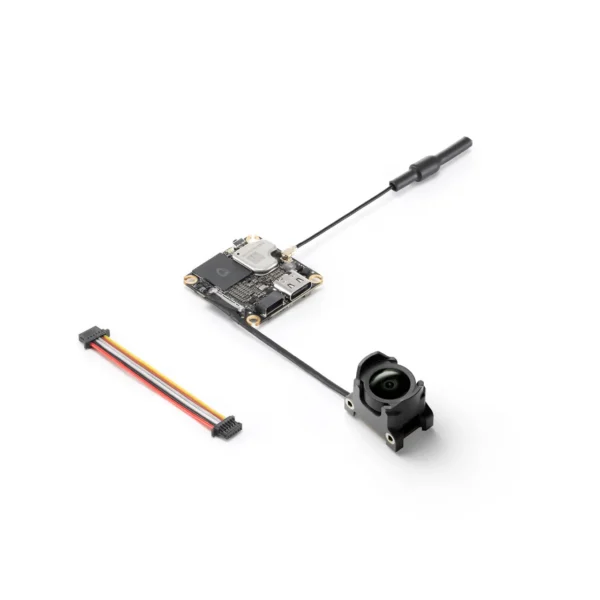
The video transmission module measures 30 × 30 × 6mm, while the camera module measures 20.5 × 14 × 20.5mm. The coaxial cable and 3-in-1 cable are both 50mm long, while the antenna measures 80mm. Input voltage ranges from 3.7 to 13.2V, and the specified operating temperature is –10 to +40°C.
Before installation, check the flight frame dimensions, camera mounting position, and available cooling. DJI O4 Wide Air Unit and DJI O3 Air Unit modules differ in size, so the O4 system may not fit a frame designed for O3 without modifying the frame or its mounts.
Effective Cooling Ensures Stable Operation
Like other high-performance digital FPV video transmission modules, DJI O4 Wide Air Unit requires adequate airflow during operation. The module should not be installed in a completely enclosed space. DJI recommends positioning it close to the airflow generated by the propellers and, where possible, using thermally conductive material to transfer heat to larger surfaces of the flight frame.
With ground low-power mode enabled, DJI O4 Wide Air Unit can remain in standby for approximately 2.5 minutes at an ambient temperature of 25°C. Additional cooling is required if the drone must remain powered on for longer before take-off, especially in warm conditions. The module’s metal housing may become hot during operation and should not be touched with bare hands immediately after use.
Compatible Goggles, Remote Controllers, and Flight Controllers
DJI O4 Wide Air Unit is compatible with DJI Goggles 3 and DJI Goggles N3 when paired with DJI FPV Remote Controller 3. DJI Goggles 2 and DJI Goggles Integra can also be used with DJI FPV Remote Controller 2. To use a DJI FPV remote controller, the flight controller must be configured to support the SBUS protocol.
Third-party FPV goggles are not supported. Third-party remote controllers using other protocols can be used with a separate receiver. Supported flight controller software includes Betaflight 4.3.0 and later, as well as INAV 8.0.1 and later. With a flight controller that supports Canvas mode, OSD data and its layout in the goggles can be customised according to the pilot’s preferences.
Who Is DJI O4 Wide Air Unit For?
DJI O4 Wide Air Unit is a strong choice for FPV pilots who prioritise the widest possible flight view while maintaining a compact and lightweight drone build. It is particularly well suited to freestyle flying, creative FPV filmmaking, technical routes, and pilots who want a single system capable of transmitting a high-quality live feed to their goggles while recording 4K video.
Compared with the standard DJI O4 Air Unit, the Wide version offers a significantly broader 159° field of view and a larger camera module. DJI O4 Air Unit Pro is designed for users who require a larger 1/1.3-inch sensor, 4K/120fps recording, and D-Log M colour mode. DJI O4 Wide Air Unit sits between these options as a practical solution, delivering an expansive and immersive image, 4K/60fps recording, and low-latency O4 video transmission in a reasonably lightweight and compact design.
DJI O4 Wide Air Unit combines a 159° ultra-wide field of view, a 1/2-inch CMOS sensor, 4K video recording, RockSteady 3.0+ stabilisation, Gyroflow support, 23GB of internal storage, and a live feed of up to 1080p/100fps. The result is a complete digital FPV solution for pilots seeking precise control, an expansive flight perspective, and high-quality recording in one compact system.

 Parcel locker: 1–3 business days
 Parcel locker: 1–3 business days