

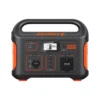
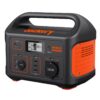

Jackery POWER STATION EXPLORER 500 518WH
659.00 € Original price was: 659.00 €.499.00 €Current price is: 499.00 €.
Jackery POWER STATION EXPLORER 500 is a compact portable power station combining a 518.4 Wh lithium-ion battery, up to 500 W continuous AC output, and 1000 W peak power. The European version provides 230 V / 50 Hz pure sine wave AC power together with USB-A and 12 V connections for phones, laptops, cameras, drone chargers, lighting, smaller refrigerators, and other compatible devices. Weighing approximately 6.4 kg, Explorer 500 can be recharged from a wall outlet, a vehicle’s 12 V system, or a compatible Jackery SolarSaga solar panel. Jackery POWER STATION EXPLORER 500 is an excellent choice for camping, campervans, road trips, photo and video productions, mobile work, and temporary backup power for smaller devices.

Jackery POWER STATION EXPLORER 500 – Compact 518 Wh Portable Power Station
Jackery POWER STATION EXPLORER 500 is a compact portable power station combining a 518.4 Wh lithium-ion battery, a 500 W pure sine wave inverter, and versatile AC, USB, and 12 V outputs. It is designed for situations where conventional mains electricity is unavailable or where a mobile backup power source is needed for electronic devices and lower-power electrical equipment.
Explorer 500 is well suited for camping, road trips, campervan use, photographers and videographers, remote work, and emergency backup power at home. Weighing approximately 6.4 kg and measuring around 30 × 19.3 × 24.2 cm, the power station is compact enough to carry in a vehicle or with camping equipment, while its 518 Wh energy capacity provides enough power to recharge phones and cameras multiple times and operate laptops, lights, smaller refrigerators, and other compatible devices.
518.4 Wh of Portable Energy Storage
At the heart of Jackery POWER STATION EXPLORER 500 is a 518.4 Wh lithium-ion battery. Capacity expressed in watt-hours indicates how much electrical energy can be stored in the power station.
This energy capacity places Explorer 500 in the compact portable power station category, where the unit remains relatively easy to transport while providing significantly more energy than a conventional USB power bank.
In practical use, this means the same power station can recharge smartphones, tablets, camera batteries, drone batteries, and laptops, while also powering smaller 230 V appliances that remain within the Explorer 500’s output limits.
Actual runtime and the number of possible recharges always depend on the connected device’s energy consumption, the power station’s state of charge, and energy losses during conversion. Therefore, the nominal 518.4 Wh capacity should not be interpreted as the exact amount of energy available to a connected appliance.
500 W Continuous Output Power
The European Jackery POWER STATION EXPLORER 500 provides a 230 V / 50 Hz AC output with up to 500 W of continuous output power.
This is an important distinction because battery capacity and inverter output describe two different characteristics. The 518.4 Wh figure indicates how much energy is stored, while 500 W determines how powerful an AC appliance the power station can operate.
Explorer 500 is therefore intended primarily for low- and medium-power devices. Laptops, monitors, televisions, camera chargers, LED lights, smaller fans, and many compact refrigerators can fall within this power range, depending on their individual specifications.
If a connected appliance requires more power than the power station can provide, Explorer 500 is not suitable for operating it.
Up to 1000 W Peak Power
Although continuous AC output is rated at 500 W, Jackery POWER STATION EXPLORER 500 can handle a short-term peak of up to 1000 W.
Peak power is particularly relevant for appliances that briefly require more energy when starting than during normal operation.
However, the 1000 W peak rating does not mean Explorer 500 is designed to continuously operate 1000 W appliances. The normal continuous consumption of the connected appliance must remain within the power station’s 500 W output limit.
Before connecting a larger appliance, its rated power and possible startup requirements should therefore always be checked.
Pure Sine Wave for Electronic Devices
The Explorer 500 inverter provides a pure sine wave AC output.
This means the AC waveform is suitable for many common electronic devices and more closely resembles conventional mains electricity than the output of simpler modified sine wave inverters.
This is particularly relevant for laptops, chargers, audio and video equipment, and other electronics where a stable AC supply is important.
For photographers and videographers, Jackery POWER STATION EXPLORER 500 can therefore serve as a mobile energy hub for charging camera, drone, and lighting batteries as well as powering other compatible equipment.
Versatile Outputs for Different Devices
Explorer 500 is not limited to a single 230 V AC outlet.
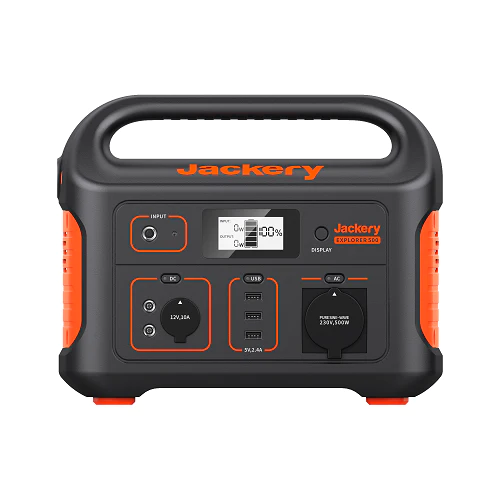
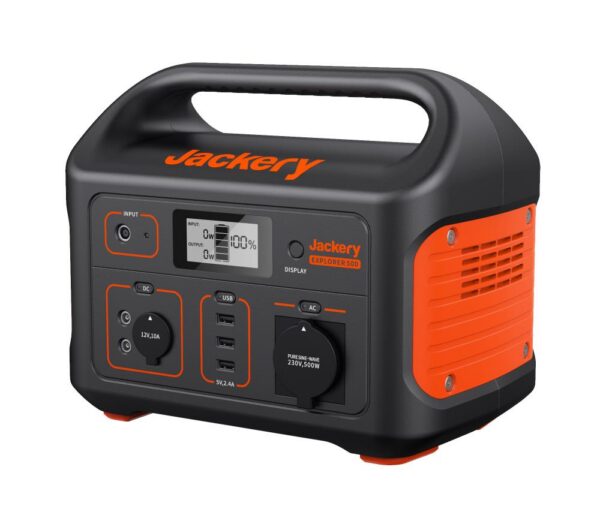
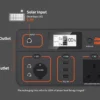
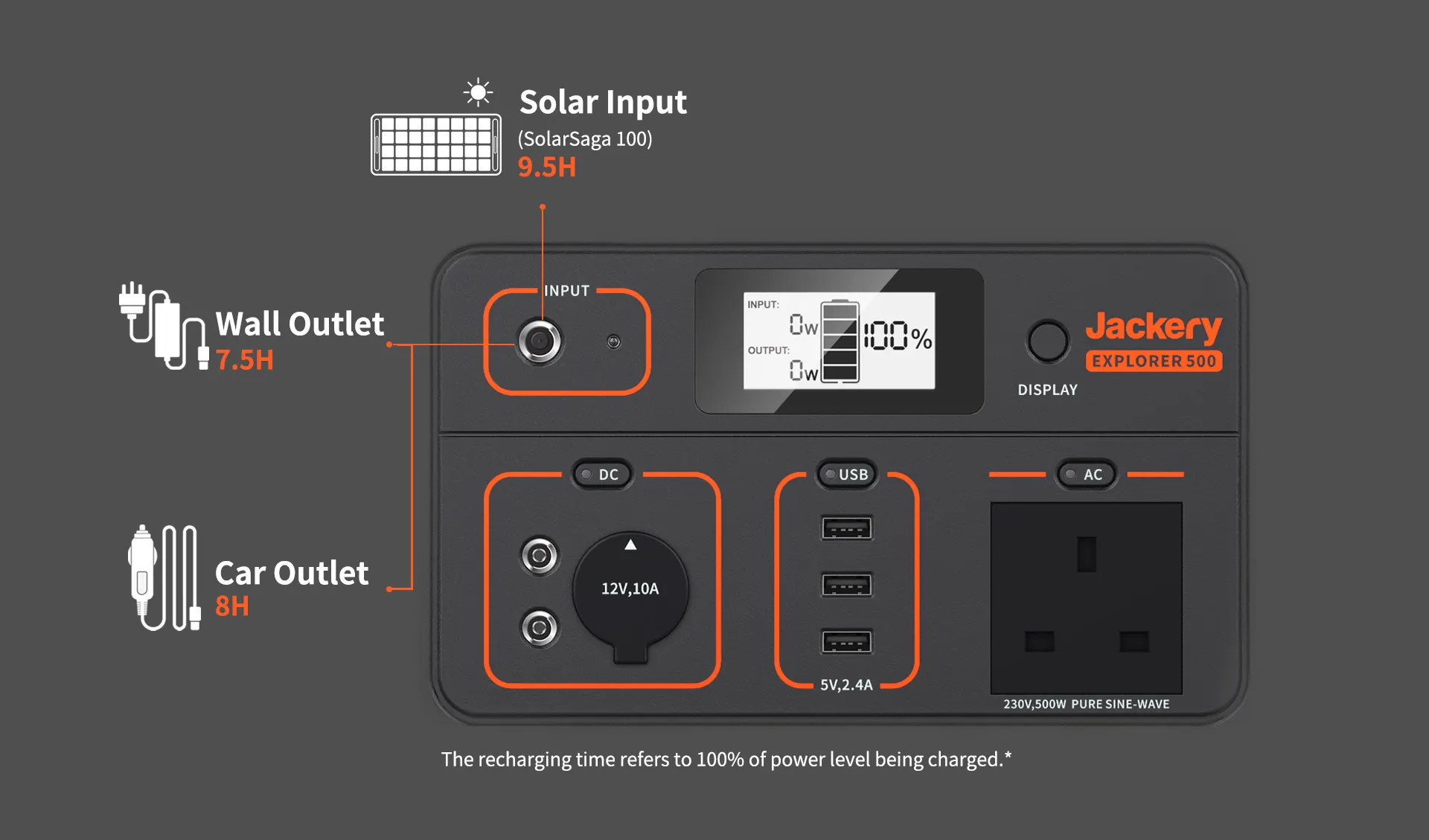
The European model provides one 230 V AC outlet, three USB-A ports, a 12 V car socket, and two additional 12 V DC outputs. The USB-A outputs provide 5 V / 2.4 A, while the car socket supports up to 12 V / 10 A.
This range of connections allows one portable power station to cover several different power requirements.
A smartphone or other USB device can be charged directly from USB-A, a laptop charger can be connected to the AC outlet, and suitable 12 V equipment can be powered from the car socket or DC outputs.
This versatility makes Jackery POWER STATION EXPLORER 500 a practical central power source for camping, road trips, and mobile workstations.
Three USB-A Ports for Mobile Devices
Explorer 500 features three USB-A outputs for charging smartphones, tablets, compact cameras, and other USB-powered devices.
Each USB-A output is rated at 5 V / 2.4 A.
Having multiple USB ports allows several mobile devices to be charged at the same time, which can be useful when travelling or camping with several people.
It is worth noting that the classic Explorer 500 does not feature the high-power USB-C Power Delivery outputs found on many newer portable power stations. USB-C devices may therefore need to be charged using their standard AC adapter through the 230 V outlet.
12 V Car Socket for Camping and Vehicle Accessories
Jackery POWER STATION EXPLORER 500 includes a 12 V / 10 A car socket for compatible 12 V equipment.
This is particularly useful for road trips and camping. Many compact car refrigerators, air pumps, and other vehicle or outdoor accessories are designed to operate from a 12 V supply.
For such equipment, using the direct DC output can be more practical than the 230 V inverter because there is no need to convert the battery’s DC power into AC and then back into DC through another adapter.
The 12 V output is therefore an important feature for campervan, camping, and road-trip use.
A Portable Power Station for Camping
Camping is one of the most natural applications for Jackery POWER STATION EXPLORER 500.
Away from the electrical grid, it can provide energy for phones, cameras, lighting, laptops, and other smaller devices. It may also power compact camping refrigerators and suitable 12 V equipment, provided their energy requirements remain within the technical limits of Explorer 500.
Unlike a petrol-powered generator, a battery power station does not require fuel or a combustion engine while supplying electricity. As a result, normal operation produces no local exhaust emissions and avoids the continuous engine noise associated with traditional generators.
This makes Explorer 500 convenient around tents, campervans, and recreational areas.
Practical for Campervans and Road Trips
On longer road trips and in campervans, power requirements often extend well beyond simply charging a smartphone.
Cameras, drones, laptops, lights, refrigerators, and other devices may require regular charging. Jackery POWER STATION EXPLORER 500 can cover part of these requirements without requiring the vehicle engine to run continuously.
At approximately 6.4 kg, the unit is compact enough to keep in a vehicle, while the integrated carrying handle makes transportation easier.
The 518.4 Wh capacity provides a useful balance between portability and stored energy: Explorer 500 is significantly more capable than an ordinary power bank without becoming a large and heavy household energy storage system.
Useful for Photographers and Videographers
A lack of mains electricity can quickly become a challenge during outdoor productions.
Camera batteries, drone batteries, LED lights, laptops, monitors, and other equipment all require energy throughout the day. Jackery POWER STATION EXPLORER 500 makes it possible to create a mobile charging station directly at the shooting location.
Its 518.4 Wh capacity provides enough stored energy to recharge multiple smaller batteries and electronic devices, while the 500 W inverter allows conventional AC chargers to be used as long as they remain within the power station’s limits.
This can be especially valuable for nature photographers, drone operators, videographers, and content creators working away from mains electricity.
Suitable for Remote Work
Explorer 500 can also serve as a practical mobile office power source.
A laptop, smartphone, mobile router, cameras, and other low-power equipment can be charged or powered even where conventional electricity is unavailable.
This makes Jackery POWER STATION EXPLORER 500 suitable for working from a campervan, carrying out fieldwork, or setting up a temporary workstation.
Actual operating time depends on the energy consumption of the connected equipment. Conversion losses also mean that theoretical calculations based purely on dividing 518 Wh by appliance wattage will not exactly match real-world runtime.
Limited Home Backup Power
Explorer 500 can also provide limited emergency backup power at home.
During a power outage, it can recharge phones and power banks and operate compatible lighting, laptops, routers, and other essential low-power devices.
Its 518.4 Wh capacity is not designed to supply an entire household for an extended period. Likewise, the 500 W inverter is not suitable for routinely operating high-power household appliances such as electric cookers, kettles, large heaters, or other demanding loads.
Explorer 500 is better suited to keeping selected smaller essential devices running during a temporary outage.
Charging from a Wall Outlet
The Jackery POWER STATION EXPLORER 500 can be recharged from conventional mains electricity.
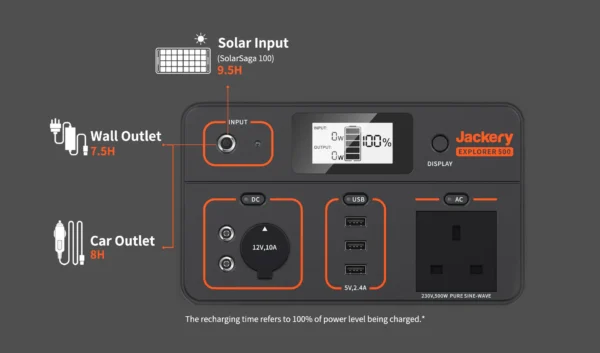
According to Jackery’s European technical information, a full charge with the AC adapter takes approximately 7.5 hours.
The power station can therefore be charged overnight before a trip or shooting day and used as a portable energy source the following day.
The classic Explorer 500 is not a modern ultra-fast-charging power station. Its strengths are instead its straightforward design, compact dimensions, and versatile functionality.
Charging from a Vehicle
Explorer 500 can also be charged from a vehicle’s 12 V electrical system.
According to Jackery, a full charge using a 12 V vehicle charging solution takes approximately eight hours, although actual charging time may vary according to the vehicle’s electrical system and operating conditions.
Vehicle charging is particularly useful on longer trips. The power station can recharge while driving and then supply phones, cameras, lighting, and other equipment after arriving at the destination.
This makes Jackery POWER STATION EXPLORER 500 particularly useful for people who regularly travel away from mains electricity.
Solar Charging Capability
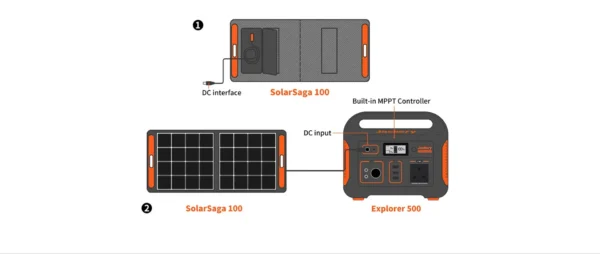
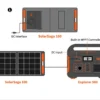
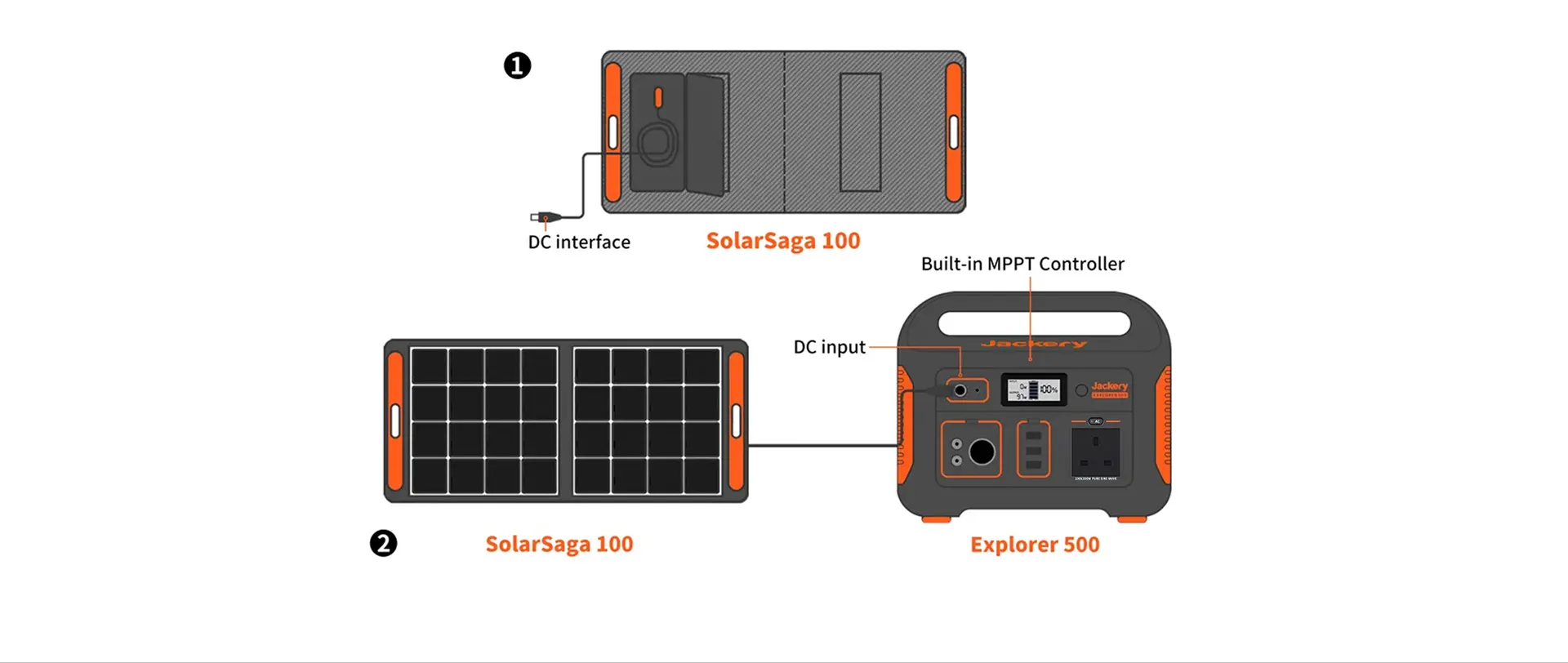
One of the important features of Explorer 500 is the ability to recharge it using a compatible Jackery SolarSaga solar panel.
The European model’s DC input supports 12–30 V, with current limited to 3.75 A, and uses a DC7909 connection.
A solar panel allows the stored energy to be replenished where no wall outlet is available. Explorer 500 and a compatible SolarSaga panel can therefore form a compact mobile solar power system.
Actual solar charging performance depends on the panel, intensity of sunlight, panel positioning, temperature, and other environmental conditions.
SolarSaga 100 Charging
According to Jackery’s European support information, charging Explorer 500 with one SolarSaga 100 panel can take approximately 6.8 hours under ideal conditions. Real-world charging can take longer depending on sunlight and environmental conditions.
Cloud cover, the angle of the sun, and shadows can significantly reduce charging performance.
Solar charging should therefore be viewed as a way of replenishing stored energy during the day rather than as a guaranteed fixed-time replacement for mains charging.
For camping and longer periods away from the grid, it can significantly increase the practical usefulness of Explorer 500.
One Solar Panel at a Time
The classic European Explorer 500 has specific DC input limitations.
According to Jackery’s European technical support information, the unit features one DC7909 input and is designed for use with one compatible solar panel at a time. Connecting two SolarSaga panels in parallel is not supported for this model because the permitted input limits could be exceeded.
This is an important distinction compared with newer and larger Jackery power stations that may support substantially higher solar input or multiple panels.
Integrated MPPT Charge Controller
Explorer 500 uses MPPT technology for solar charging.
MPPT, or Maximum Power Point Tracking, helps the charging system make efficient use of the energy available from a solar panel according to current lighting conditions.
Solar panel output changes continuously depending on sunlight, temperature, and panel position. An MPPT controller helps the charging system adapt to these changes.
This is particularly useful for users planning to combine Jackery POWER STATION EXPLORER 500 with a SolarSaga panel on longer off-grid trips.
LCD Display for Monitoring Energy Use
The LCD display on the front of Explorer 500 allows users to monitor the operating status of the power station.
It helps users assess the remaining battery level and monitor energy input and output. This becomes particularly useful when the power station is used away from mains electricity for an extended period.
Users can plan energy consumption more effectively and determine when the unit should be recharged.
When camping, for example, the display can help estimate whether enough energy remains for overnight refrigeration, lighting, and mobile-device charging.
Integrated LED Light
Jackery POWER STATION EXPLORER 500 also features an integrated LED light.
This can be useful while camping, in a vehicle, in a garage, or during a power outage when a separate flashlight is not immediately available.
The LED light is not the power station’s primary function, but it adds practical value in outdoor and emergency situations. The model also includes an SOS lighting function.
Battery Management and Protection System
A large lithium-ion battery requires controlled charging and discharging.
Explorer 500 uses a Battery Management System (BMS) to monitor important operating parameters and provide electronic protection functions.
These include protection related to overvoltage, undervoltage, overcurrent, short circuits, and excessive temperature.
The BMS does not make the power station immune to misuse, and the manufacturer’s safety instructions should always be followed, but these electronic protection systems are an important part of a modern portable power station.
Compact Body and Approximately 6.4 kg Weight
Portability is an important consideration for a mobile energy storage system.
Jackery POWER STATION EXPLORER 500 measures approximately 30 × 19.3 × 24.2 cm and weighs around 6.4 kg.
These dimensions make it compact enough to store in a car boot, campervan, or home equipment cupboard. An integrated carrying handle makes it easier to move when required.
Explorer 500 is not a pocket-sized power bank, but within its energy class it remains a genuinely portable solution.
Operating in Temperatures Down to –10°C
According to Jackery’s European specifications, Explorer 500 can discharge at temperatures of approximately –10 to +40°C, while charging is intended for temperatures between 0 and +40°C.
This distinction is important.
The power station may be used under certain sub-zero conditions, but a lithium-ion battery that is frozen or too cold should not be charged. If the unit has been stored below freezing, it should be allowed to warm to the manufacturer’s permitted charging temperature before recharging.
This should be taken into account during winter camping or when storing the power station in a vehicle.
What Can Jackery Explorer 500 Power?
Jackery POWER STATION EXPLORER 500 is primarily designed for devices with continuous power consumption below 500 W.
Depending on the specific model, this may include smartphones, tablets, laptops, camera and drone chargers, LED lights, televisions, projectors, CPAP devices, fans, and smaller refrigerators.
The actual power requirements of the connected equipment should always be checked. Devices within the same product category can differ significantly in consumption.
Particular attention should be paid to appliances containing electric motors, compressors, or heating elements, as their startup or continuous power requirements can be higher than expected.
What Is Explorer 500 Not Designed For?
The 500 W inverter creates clear operating limits.
Jackery POWER STATION EXPLORER 500 is not designed for continuous use with high-power kettles, electric cookers, large coffee machines, hair dryers, powerful heaters, or other appliances that typically consume more than 500 W.
The 1000 W peak rating should also not be interpreted as permission to continuously operate a 1000 W appliance.
The rated consumption of an appliance should always be checked before connection. If a device continuously requires more than 500 W, a power station with a higher-output inverter should be selected.
A Quiet Alternative to a Small Fuel Generator
One practical advantage of a battery power station over a combustion-engine generator is quieter operation.
Explorer 500 does not require petrol or diesel to supply stored electricity and has no continuously running combustion engine. This makes it well suited to camping, campervans, and other environments where generator noise would be disruptive.
Using the battery also produces no local exhaust emissions.
This makes Explorer 500 a convenient power source around campsites and, when used according to the manufacturer’s safety instructions, for supporting suitable low-power devices in indoor backup situations.
Related products
Nanlite – Lumipad 25
PolarPro – Mavic 3 FX Collection
Gomatic 30L Travel Bag V2
DJI RS 2 – 3D Focus System
Nanlite – Forza 60C RGBLAC led spotlight
EcoFlow – Smart Home Panel Combo (smart shield + relay)
Nanlite MixPad 27C II RGBWW LED Panel
DJI FPV – Gimbal camera module