
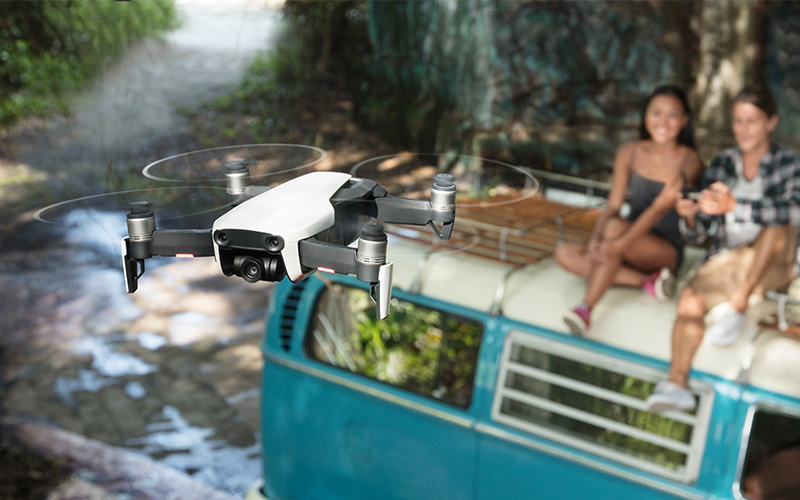
The first flights with the aerial glider have been made and first impressions are there. Let it be said right away that this is not an in-depth analysis of the Air’s capabilities, but first impressions after picking up the drone and taking the first flights.
Design
Air is tiny. It’s considerably smaller than the big Mavic and smaller than the Spark when folded. The gimbal is similar in design to the Spark’s, doesn’t clunk around outside but feels stronger in every way and better protected. On the downside, perhaps, the Pro gimbal has more freedom of movement, while on the Air the gimbal reaches the limiters sooner. The gimbal guard is exceptionally well-designed and just clicks into place without any carving, unlike a large earthmover.
You can’t fold the air props, but it doesn’t directly interfere. The folding of the arms is similar to the Pro, only everything works on a much smaller scale. While the Pro looks like a larger-scale robotic Lego, the Air is much more streamlined and compact, in every sense.
The Air’s console is more like the Spark’s – no screen and fewer buttons. For example, you can’t use the shutter compensation dial. And you have to unscrew the levers from the remote and click them into the holders on the remote to fit it in the bag. Since they’re going to disappear sooner or later anyway, a spare pair is included.
On the plus side, the bag itself (in the case of the Fly More kit) is a much better design and things fit inside without frustration, unlike the Pro.
Camera
At first glance, the Air and Pro cameras look almost identical, but there are small, not to say significant, differences. They both have 12 megapixels and can record up to 4K video. The Air’s angle of view is a bit wider, 24 mm full-frame vs the Pro’s 28 mm. The Pro’s optics are more luminous, f/2.2 vs f/2.8.
However, the video quality of Air seems to be better – both in theory and in practice. While the Pro has a maximum video data rate of 60 Mbps, the Air has 100 Mbps. Which, simply put, means less compression and a more natural picture. And that’s exactly what it looks like. The Air post-processes video less, and the automatic white balance handles it better too. Even the gimbal seems to be more stable, and there was no “jelloing” when flying in strong winds, and in the case of the photo, you got a perfectly sharp picture even at 1/8 or even 1/4 focus. However, there are no S-Log video profiles on the Air, only Cinelike.
Air’s slow motion video is slower (or faster) – 120 fps vs Pro 96 fps (1080 fps).
Airi’s camera has a fixed focus. Yes, in theory you can get a more artistic DOF image with the Pro, but in practice you may get a blurry image. With the Air, there’s no fiddling with focus, everything is sharp, and for a small drone that’s only a good thing.
The Air also has more shooting modes, and a 360-degree panorama (made up of 25 photos) can be recorded at 32 megapixels – not bad.
In fact, there are already too many modes to be honest, but at least if you get bored, you can always find something new to occupy your drone time.
Flight characteristics
Mavic Air is DJI’s smartest drone. Sensors (or rather cameras) are also on the back and there’s a mode called APAS – Automatic Pilot Assistant System. This means that when it detects an obstacle, the drone doesn’t ‘freeze’ in mid-air (which is annoying at times), but flies left or right or over the obstacle. We haven’t had the chance to do a very thorough test on this yet, but first impressions aren’t bad.
In terms of speed, the Air is even marginally more capable – 68.4 km/h vs Pro 65 km/h, but it’s worth bearing in mind that this is Sport mode, where all the ‘smart’ modes and obstacle detection don’t work. In normal mode, again, the Pro feels crisper, in every sense of the word – uphill, downhill and horizontal. We haven’t quite put them on the line yet, but we will.
The Air doesn’t fly very far, at least compared to the Pro. The connection works over enhanced WiFi and the maximum theoretical range (CE) at 2.4 Ghz is 2 km. In practice, I was able to go up to a kilometre, but in another place I had problems at a few hundred metres. Anyway, the old Pro and Ocusync are definitely more stable in this respect. It’s also worth mentioning that Ocusync works wirelessly with the Goggles, while with the Air you have to use a cable between the glasses and the remote.
Air is noisier. Not by much, but still. While the Pro makes a peaceful drone noise, the Air is an excited wasp. However, when you compare the Air to the Pro Platinum, the difference in the Platinum’s favour is very noticeable.
The Air’s battery is longer and lasts a little less – 21 theoretical minutes vs Pro 28.
Not many people may be interested, but DJI has also significantly improved Gesture Control on the Air. You can now lift the drone off the ground, land it, fly it further and closer, not to mention take pictures and videos. Once you learn the hand signals, Gesture Control is actually pretty cool.
Summary
DJI is very good at positioning its products on the feature/price scale, which is no surprise. When you put three relatively miniature drones – Spark, Air and Pro – side by side, the Air currently offers the most ‘bang for the buck’, there’s no doubt about that. In the Pro’s favour are mainly the Ocusync and a bit longer flight time, and for those who are interested, the S-Log profiles, but the Air is fiercer in every way – much smaller and smarter, while making more beautiful video. And costs less than the Pro.
Winter night pictures with Mavic Air
Click on the image to view full size.


