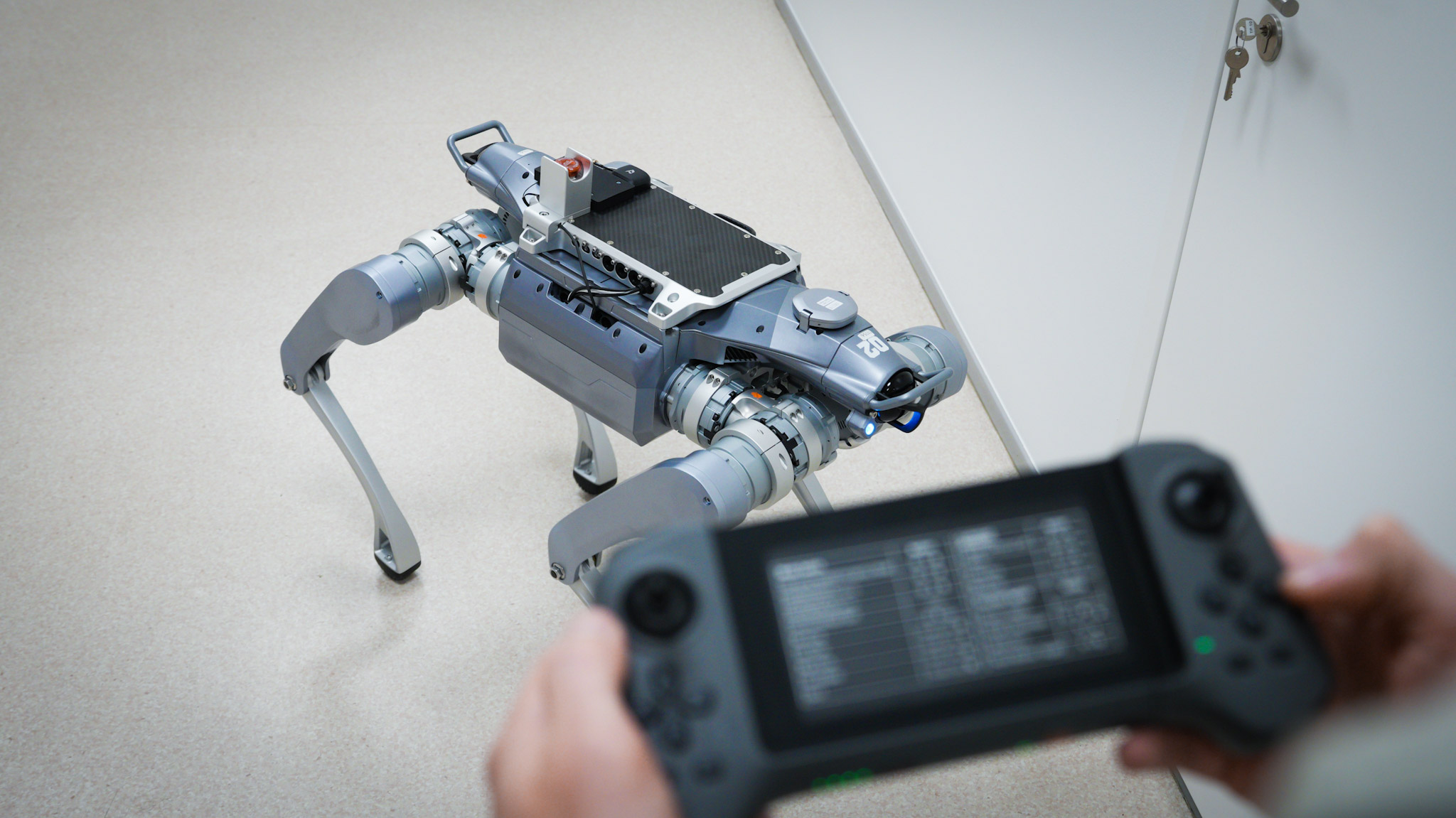
Robots in education are no longer just a topic for the future. They are becoming an increasingly practical part of modern learning. Humanoid robots and other robotics platforms give pupils and students new ways to explore technology.
Programming can be learned on a screen, but a robot makes code move in the real world. When a pupil’s programme makes a robot dog walk up the stairs or a humanoid raise its hand, theory immediately becomes practical experience. In this article, we look at what you can learn with robots, which robot is right for a school or a university, and how to get started using one in teaching.
What can you learn with a robot?
When learning with a robot, pupils and students can immediately see how their programme affects the robot’s movements and behaviour.
- Programming and robotics: creating movement tasks, control logic and testing programmes on a physical robot.
- Artificial intelligence and computer vision: projects that use camera and sensor data to identify objects and control the robot’s behaviour.
- Autonomous movement: exploring environment mapping, localisation, route planning and obstacle avoidance with a suitable configuration.
- Mechatronics and automation: learning about motors, sensors, balance and control systems, as well as how hardware and software work together.
- Manipulation: with a robot arm included, testing how to pick up and move objects and how a mobile base and arm work together.
- Student projects and research: interdisciplinary tasks that combine programming, physics, mathematics and engineering.
In general education, teacher-led demonstrations and simpler tasks are a good fit. Vocational schools and higher education institutions can go further into development and experimentation.
Hands-on robotics: Narva College
A robot dog walks across the laboratory floor, stops in front of a table and picks up an object with its robotic arm. At Narva College, this is part of everyday teaching. Our partner has two Go2 EDU robot dogs equipped with D1 robotic arms. This lets students use the same robot to experiment with both movement and object manipulation, quickly putting theory into practice.
Every school teaches robotics in its own way, so we do not offer the same kit to everyone. We select the hardware and development access according to the school’s learning objectives. The school can create its own teaching software. If support is needed, we can help with development.
Why is it worth learning robotics?
Robots are moving out of laboratories and into real workplaces, including factories, warehouses, the energy sector and service industries. This is increasing the need for people who can programme, configure and maintain robots. A pupil who has made a robot dog move using their own code gains a better understanding of how software and the real world work together.
What might a learning project look like?
Imagine a group of students is given the following task: a robot dog must find a specific object in a room, move towards it and pick it up with its robotic arm. One task can cover several topics at once.
- Recognition. The first subgroup teaches the robot to identify the object using camera footage.
- Movement. The second subgroup plans a route that takes the robot to the object while avoiding obstacles.
- Grasping. The third subgroup programmes the robotic arm to pick up the object and move it somewhere else.
- Integration and testing. Finally, the parts are brought together and tested in a real room. This is where it becomes clear which ideas worked in theory and which did not.
The value of a project like this is that mistakes are visible and specific. If the robot goes the wrong way or drops the object, the students need to find the cause and fix it. This is exactly the kind of process engineers use in real-world projects.
Which robot is right for a school, and which for a university?
| | Unitree Go2 EDU | Unitree G1 EDU |
|---|---|---|
| Type | Quadruped robot dog | Humanoid robot |
| Suitable for | Upper secondary schools, vocational schools and introductory higher education courses | Universities, higher education institutions, research and development laboratories |
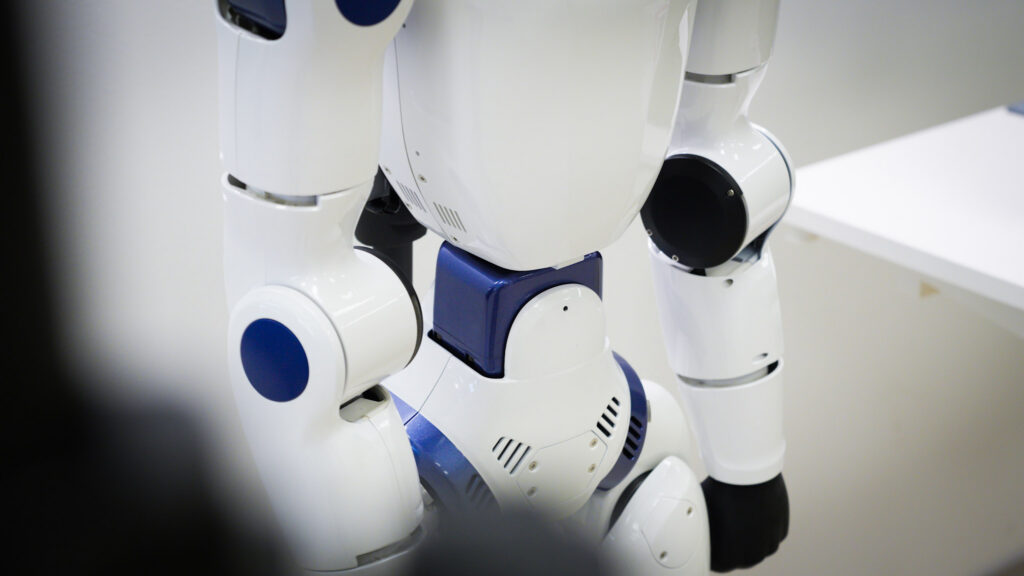
| Size and weight | 70 × 31 × 40 cm, 15 kg | Approx. 1.3 m tall, approx. 35 kg |
| Sensors | 4D LiDAR L1, depth and wide-angle camera | Depth camera, 3D LiDAR, 4 microphones |
| Operating time | Up to 2 h (2–4 h with an additional battery) | Approx. 2 h |
| Development | ROS, C++; optional NVIDIA Jetson Orin Nano (up to 40 TOPS) | NVIDIA Jetson Orin NX 16 GB (100 TOPS); 23–43 joints, depending on the version |
In short: Go2 is a better first robot. It is smaller, more durable and easier to get started with for programming. G1 is a tool for universities and laboratories researching human-like movement and artificial intelligence.
How do you get started?
- Set a goal. Is the robot for programming classes, thesis projects or research? The answer will help determine which model is suitable.
- Start with one and add more later. One robot and group work are better than having several robots that nobody knows how to use.
- Prepare the teacher. The teacher should try out the first lessons themselves. The manufacturer’s documentation and sample code make it easier to get started.
- Connect the robot to a real task. For example, “find the red object in the room” or “walk through the corridor and create a map”.
Would you like to learn more about how robots are used in teaching and development?
A demo day will take place at Tallinn University of Applied Sciences on 10 November 2026. Meridein, Droon.ee and TTK will discuss which technologies are already ready for use and practical application, which limitations still need to be overcome, and how to find the right robotic solution for a company’s needs.
Would you like to find out which robot is right for your school or laboratory?
Get in touch: robotics@meridein.ee