DJI Zenmuse H20N
12,690.00 € Original price was: 12,690.00 €.7,799.00 €Current price is: 7,799.00 €.
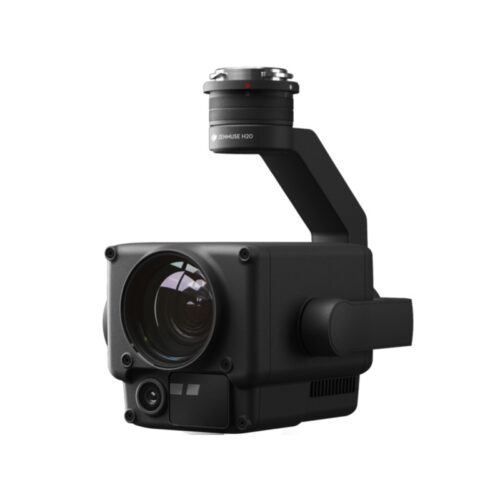
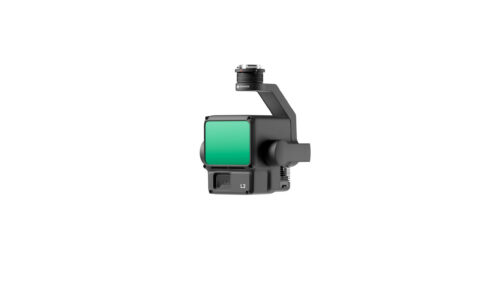
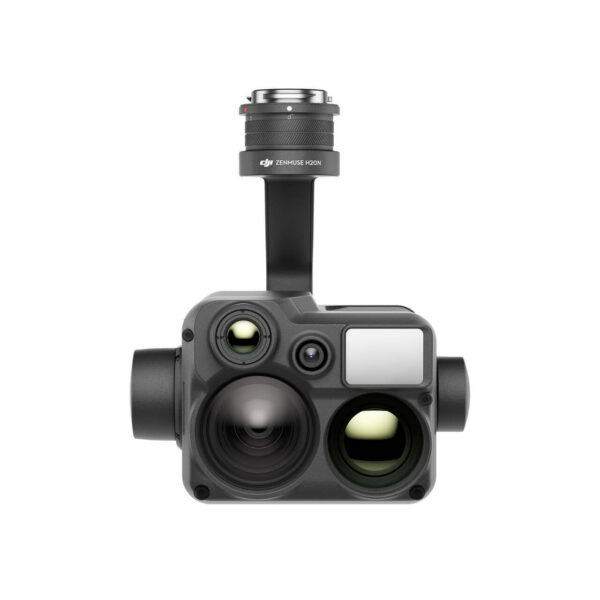
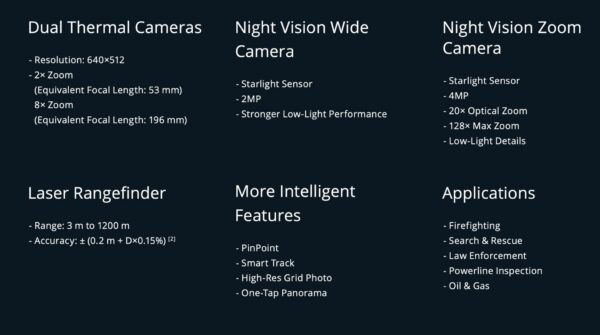
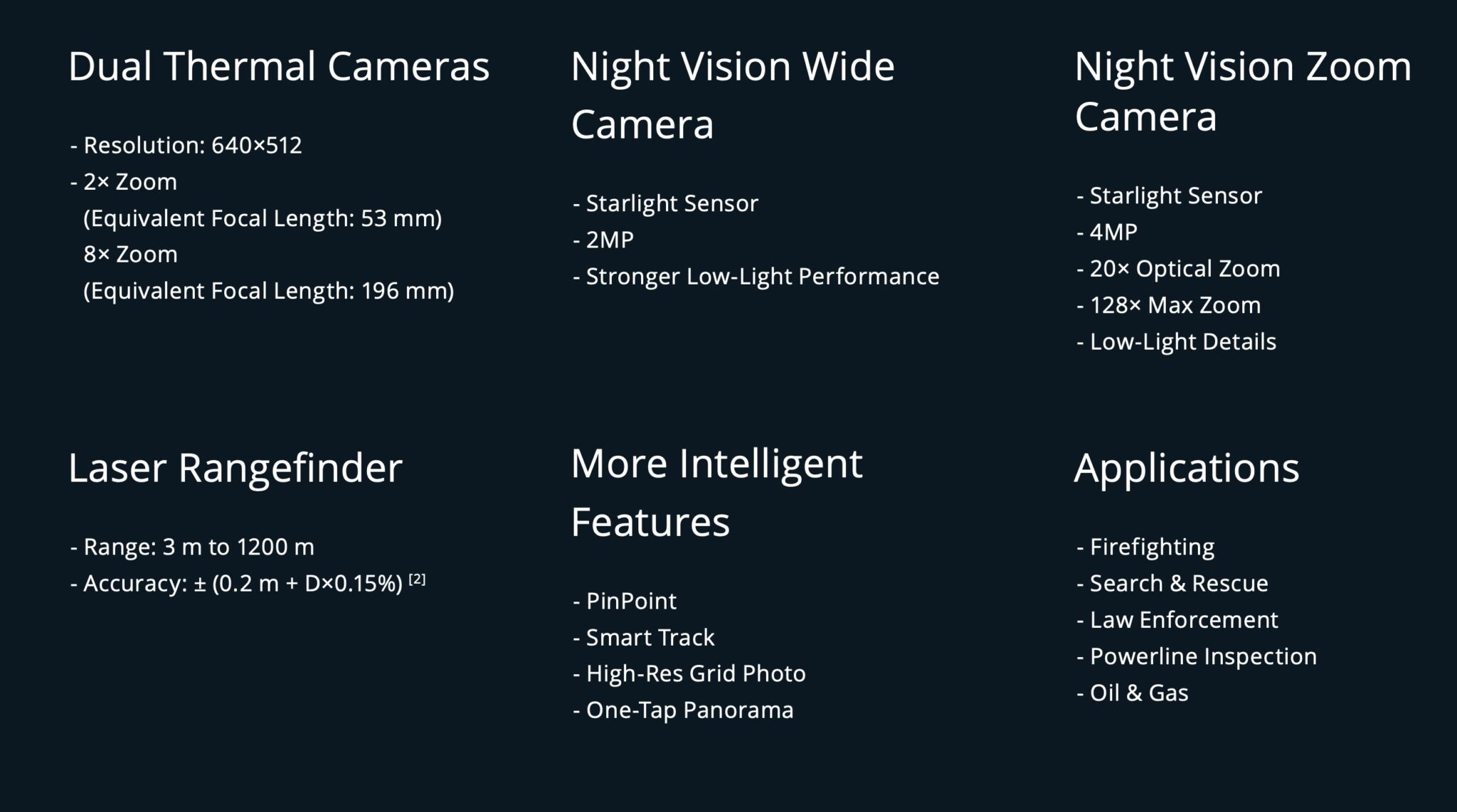
DJI Zenmuse H20N is a professional multisensor camera system for nighttime and low-light drone operations, combining a 4 MP starlight zoom camera, a 2 MP wide-angle camera, two 640 × 512 thermal cameras, and a laser rangefinder with an operating range of up to 1200 m. Up to 20× optical zoom, synchronized visible and thermal zoom, and radiometric temperature measurement enable detailed observation of the same target in both visible and infrared spectrums. With an IP44 protection rating and an operating temperature range of –20 to +50°C, DJI Zenmuse H20N is particularly well suited to infrastructure and energy inspections, search and rescue operations, and professional nighttime observation.
“N” for Night Vision
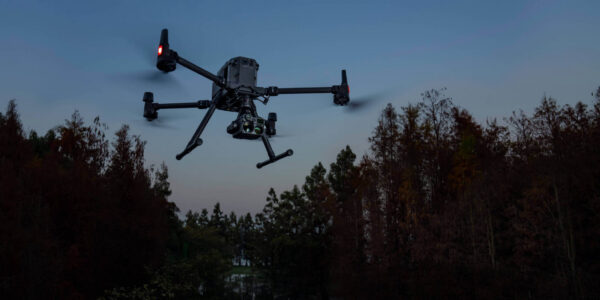
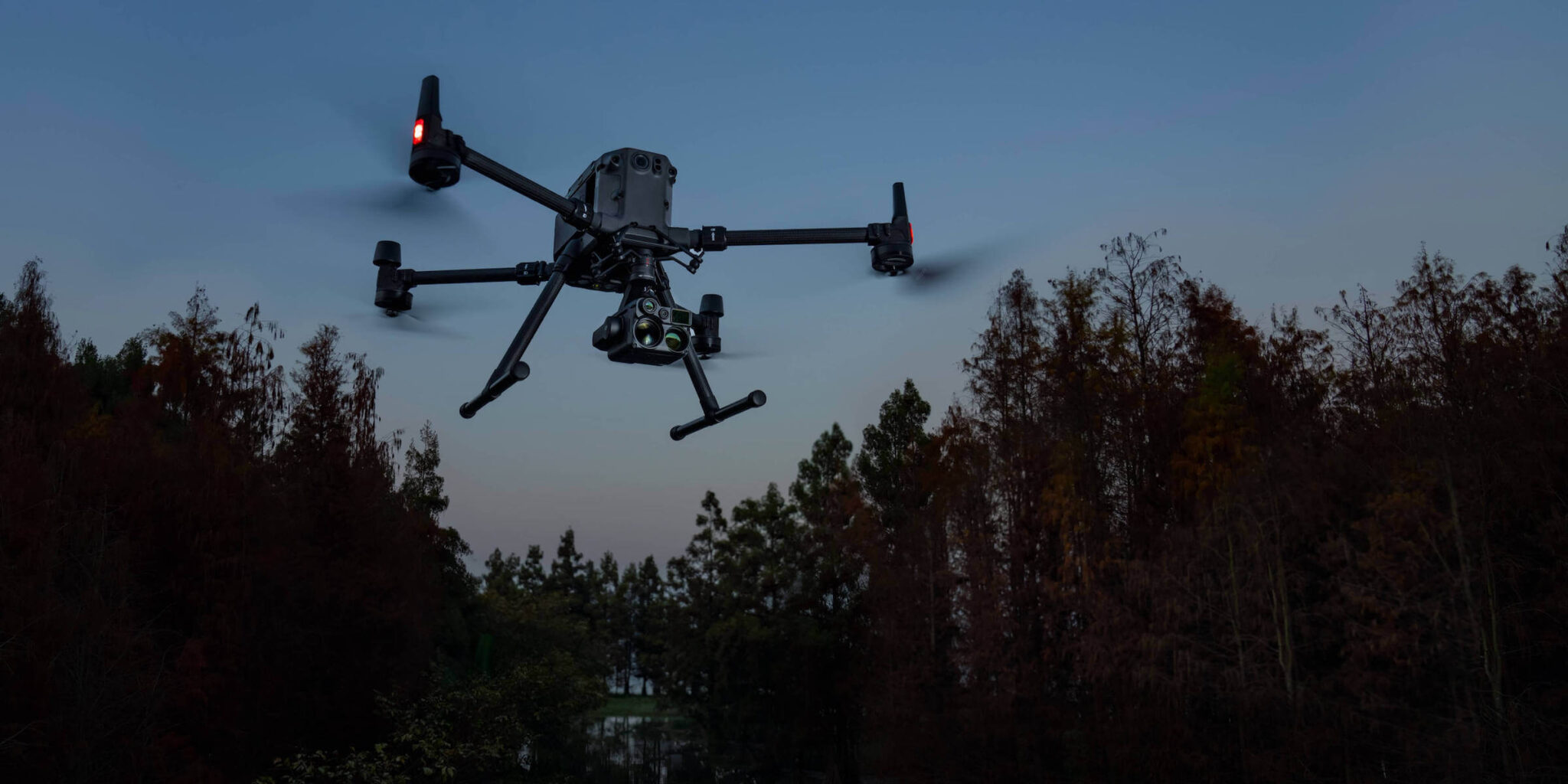
The Zenmuse H20N integrates starlight sensors1 into its zoom and wide-angle cameras. Pair this with dual zoom thermal cameras and a laser rangefinder, and you have a versatile hybrid payload that rises to the occasion.
DJI Zenmuse H20N – Professional Multisensor System with Night Vision and Thermal Cameras
DJI Zenmuse H20N is a professional multisensor camera system designed primarily for nighttime operations, low-light environments, and drone missions requiring thermal analysis. The H20N combines a starlight wide-angle camera, a powerful night-vision zoom camera, two thermal cameras with different fields of view, and a laser rangefinder in a single stabilized payload. This combination allows operators to obtain a wide overview, inspect distant details, detect heat sources, and measure the distance to a target during the same flight.
DJI Zenmuse H20N is designed for professional workflows where a conventional daylight camera is not sufficient. Its key strength is its ability to operate in challenging lighting conditions. The wide-angle and zoom cameras use starlight sensors optimized for low-light environments, while the two thermal cameras make it possible to detect temperature differences and heat sources even in complete darkness.
The H20N is therefore well suited to infrastructure inspection, power grid and industrial facility inspection, search and rescue operations, nighttime observation, and other professional applications where visual, thermal, and distance information needs to be available from a single aerial platform.
Starlight Night Vision for Low-Light Environments
The “N” in DJI Zenmuse H20N refers to its Night Vision capabilities. Both the wide-angle and zoom cameras use sensors specifically optimized for operation in low-light conditions.
According to DJI, the system can distinguish people and vehicles from approximately 150 metres away under clear starlight conditions. Actual viewing distance will always depend on ambient illumination, weather, target contrast, camera settings, and other environmental factors.
Starlight technology is designed to allow visible-light cameras to continue operating in situations where a conventional daylight camera would already produce an extremely dark or noisy image. This is useful for nighttime patrols, facility inspections, search operations, and locations where artificial lighting cannot be used.
4 MP Night-Vision Zoom Camera
The DJI Zenmuse H20N zoom camera features a 1/1.8-inch CMOS sensor with an effective resolution of 4 megapixels. Its lens has an actual focal length of 6.8–119.9 mm, corresponding to approximately 32.7–574.5 mm in 35 mm equivalent terms.
The aperture ranges from f/1.6 to f/11. The wide f/1.6 aperture at the wide end is particularly useful in low-light conditions because it allows more light to reach the sensor.
DJI positions the system as offering 20× optical zoom and up to 128× maximum zoom for nighttime observation. This makes it possible to examine distant subjects without always having to fly the drone significantly closer.
In professional applications, this level of zoom is particularly useful for inspecting tall structures, towers, power lines, industrial equipment, and other difficult-to-access targets.
High ISO Sensitivity for Night Operations
The DJI Zenmuse H20N zoom camera offers sensitivity up to ISO 102,400 for both photos and video.
High maximum sensitivity enables the camera to operate in environments where very little light is available. Increasing ISO can also increase image noise, which is why the H20N Night Scene mode incorporates additional processing and noise-reduction capabilities.
In Night Scene mode, longer shutter speeds can be used for video than in conventional video operation. With enhanced noise reduction enabled, the electronic shutter can operate down to 1/5 second, helping the camera collect more light in extremely dark environments.
Intelligent Night Scene Image Enhancement
DJI Zenmuse H20N features a dedicated Night Scene mode designed to improve the usability of its visible-light cameras in challenging nighttime conditions.
With enhanced noise reduction enabled, the camera can reduce visible digital noise and improve the visibility of details in low-light scenes. This processing also affects frame rate because the system uses longer exposure times and additional image processing.
Night Scene mode is particularly valuable when the thermal camera clearly detects a heat signature but the operator also needs to visually identify the object using the visible-light image.
2 MP Wide-Angle Camera for Situational Awareness
Alongside the zoom camera, the H20N features a 2 MP 1/2.7-inch CMOS wide-angle camera.
Its 4.5 mm lens corresponds to approximately 29 mm in 35 mm format and provides a 73.6° diagonal field of view. The lens has an f/2.8 aperture.
The purpose of the wide-angle camera is to provide the operator with clear contextual information. At high zoom levels, the field of view becomes very narrow, making it difficult to determine exactly where a particular detail is located in relation to the larger subject. The wide-angle view helps maintain situational awareness and locate areas of interest before switching to detailed zoom observation.
The wide-angle camera also supports sensitivity up to ISO 102,400 and Night Scene functionality.
Two 640 × 512 Thermal Cameras in One System
One of the defining features of the DJI Zenmuse H20N is its dual thermal-camera system.
Both thermal cameras use uncooled VOx microbolometers with a resolution of 640 × 512 pixels, a 12 μm pixel pitch, and an 8–14 μm spectral range.
The dual-camera configuration is designed to provide both a wider thermal overview and significantly improved long-distance thermal observation. One camera uses a wider field of view, while the second uses a telephoto lens, allowing operators to move from general thermal situational awareness to a more detailed examination of distant heat sources.
This distinguishes the H20N from many conventional drone thermal cameras that use only a single fixed-focal-length thermal sensor.
Wide Thermal Camera for General Observation
The H20N wide thermal camera uses a 12 mm f/1.0 lens, corresponding to approximately 53 mm in 35 mm equivalent terms. Its diagonal field of view is 45.5°.
The focusing range begins at approximately five metres, and the camera provides up to 4× equivalent digital zoom.
The wide thermal camera is particularly suitable for quickly surveying larger areas. During a search operation, for example, it can help identify objects that differ in temperature from their surroundings. During an industrial inspection, it can be used to assess a larger section of a facility before switching to the telephoto thermal camera for closer examination.
Telephoto Thermal Camera for Detailed Long-Range Observation
The second thermal camera uses a 44.5 mm f/1.2 lens, corresponding to approximately 196 mm in 35 mm equivalent terms.
Its diagonal field of view is only 12.5°, giving it a significantly narrower telephoto perspective. The focusing range begins at approximately 45 metres.
The telephoto thermal camera supports 16× and 32× equivalent digital zoom. DJI describes the dual thermal-camera configuration as providing 2× and 8× optical zoom capabilities, designed to extend the effective range of thermal observation.
This is particularly useful when an operator detects a heat signature with the wide thermal camera and then needs to examine it in greater detail from a longer distance.
Synchronized Visible and Thermal Zoom
DJI Zenmuse H20N supports Synchronized Split-Screen Zoom.
This feature links visible-light and thermal zoom so that both views can be magnified simultaneously. When synchronized, the thermal and visible images change together.
In practical operation, this helps keep the same subject in both views. For example, an operator can detect a suspicious heat source with the thermal camera while simultaneously using the visible-light zoom camera to visually identify the object.
This reduces the need to manually align two separate camera views and can make professional operations faster and more efficient.
Point and Area Temperature Measurement
The thermal cameras of the DJI Zenmuse H20N do more than simply display a thermal image. They support radiometric temperature measurement.
Operators can use both spot measurement and area measurement. Spot measurement provides the temperature of a specific pixel or target point, while area measurement allows temperatures across a larger selected region to be analyzed.
This is useful for thermal inspection of industrial equipment, electrical connections, solar panels, buildings, and other infrastructure.
Drone-based temperature measurement does not necessarily replace contact measurement or certified thermographic assessment, but it provides an efficient way to identify areas that require closer inspection.
Temperature Measurement up to 500°C
The H20N thermal cameras offer two primary measurement modes.
In High Gain mode, the measurement range is approximately –20 to +150°C. The narrower temperature range allows the system to be more sensitive to smaller temperature differences.
In Low Gain mode, the measurement range extends from 0 to 500°C, enabling the observation of significantly hotter objects and industrial processes.
Operators can select the appropriate mode depending on whether the priority is distinguishing smaller temperature variations or observing very high temperatures.
NETD ≤50 mK for Detecting Small Temperature Differences
Thermal-camera sensitivity is described by NETD, or Noise Equivalent Temperature Difference. According to DJI specifications, the H20N thermal cameras have an NETD of ≤50 mK @ f/1.0.
In general, a lower NETD allows a thermal camera to visually distinguish smaller temperature differences.
This level of sensitivity is valuable when inspecting electrical connections, equipment, or building components where a problem may not produce extremely high temperatures but instead appear as a relatively subtle thermal difference.
R-JPEG Files Preserve Thermal Information
DJI Zenmuse H20N thermal photographs are stored in R-JPEG format, which includes 16-bit raw data and temperature-related information.
This means that a thermal image is not simply a conventional JPEG converted into a colored thermal palette. Thermal information is stored with the image and can subsequently be analyzed using DJI Thermal Analysis Tool software.
During post-processing, users can analyze temperatures and adjust parameters such as emissivity and reflected temperature.
This is particularly important for professional inspection because complete thermal analysis does not have to be performed during the flight. Data can be recorded, archived, and analyzed in greater detail later on a computer.
Multiple Thermal Color Palettes
DJI Zenmuse H20N provides multiple display palettes to make thermal imagery easier to interpret.
Available options include White Hot, Black Hot, Iron Red, Hot Iron, Arctic, and Rainbow.
Different palettes do not change the measured temperature itself, but they can make certain objects or temperature differences easier to identify visually.
For example, White Hot is intuitive for many observation tasks, while colored palettes can help emphasize temperature gradients.
Temperature Alerts for Operational Monitoring
The H20N thermal camera also supports a temperature alert function.
This allows operators to focus attention on situations where the temperature of an observed area reaches or exceeds defined conditions.
The feature can be useful in industrial inspections where the objective is to identify unusually hot components or in situations where continuously checking a large number of objects manually would be inefficient.
Laser Rangefinder with up to 1200 m Range
In addition to its four camera sensors, DJI Zenmuse H20N integrates a laser rangefinder.
Under DJI’s specified test conditions, its measurement range is 3 to 1200 metres. Measurement accuracy is ±(0.2 m + D × 0.15%), where D represents the distance to the target.
The rangefinder operates at a wavelength of 905 nm and is classified as Class 1M.
It provides distance information alongside visual and thermal data, which can be useful for search operations, infrastructure inspection, and improving overall situational awareness.
Stabilized Gimbal for High-Zoom Observation
The H20N multisensor camera system is mounted on a three-axis stabilized gimbal.
Angular vibration is rated at ±0.01°, which is particularly important when using high magnification or the narrow field of view of the telephoto thermal camera. The greater the magnification, the more noticeable even small movements become.
The gimbal provides a controllable pan range of ±320° and a tilt range from –120° to +60°. Maximum control speed is 90° per second on both pan and tilt axes.
This range of movement allows operators to track targets and inspect structures from different angles without having to significantly reposition the aircraft each time.
IP44 Protection for Professional Field Operations
DJI Zenmuse H20N has an IP44 protection rating.
In the context of the IP standard, this provides protection against solid foreign objects larger than one millimetre and water splashes from different directions. IP44 does not mean that the camera is waterproof or suitable for unrestricted use in heavy rain or underwater.
The protection rating supports professional outdoor use, but operators must always consider weather conditions, aircraft operating limitations, and DJI’s instructions.
Operating Temperature from –20 to +50°C
The official operating temperature range of the DJI Zenmuse H20N is –20 to +50°C, while its storage temperature range is –20 to +60°C.
The broad operating range supports professional use across different seasons and climate conditions, which is particularly valuable in infrastructure, energy, and public-safety workflows.
Cold and hot environments also affect aircraft batteries and the overall flight system, so the operating limits of the complete drone platform must always be considered separately.
Compact System with Five Sensor Functions
Despite its multiple integrated sensors, the H20N remains a single complete camera payload.
Its dimensions are approximately 178 × 135 × 161 mm, with a weight of 878 ± 5 g.
The housing integrates two visible-light cameras, two thermal cameras, and a laser rangefinder. This combination reduces the need to switch between separate camera payloads for different missions.
During a single flight, operators can move between wide night vision, powerful visible-light zoom, wide thermal observation, telephoto thermal observation, and distance measurement.
Up to 128 GB microSD Support
DJI Zenmuse H20N supports UHS-I Speed Grade 3 microSD cards up to 128 GB and uses the exFAT file system.
A sufficiently fast and high-capacity memory card is important in professional workflows because a single flight can generate visible-light video, JPEG photographs, and radiometric R-JPEG thermal images.
Systematic data storage is particularly important for recurring inspections where imagery and temperature data collected on different dates need to be compared.
Suitable for Nighttime Search and Rescue Operations
The combination of starlight cameras and two thermal cameras makes DJI Zenmuse H20N well suited to supporting search and rescue operations in low-light environments.
The thermal cameras can help identify objects with a temperature difference even when the visible-light camera cannot yet provide a sufficiently clear image. Once a thermal target has been detected, the starlight zoom camera can be used to assist with visual identification.
Synchronized zoom helps keep thermal and visible views aligned, while the laser rangefinder provides additional information about target distance.
Efficient for Infrastructure and Energy Inspections
In industrial and energy applications, the value of the H20N lies in its ability to perform visible-light and thermal inspection during the same flight.
The zoom camera can be used to examine structural details and visible damage, while the thermal cameras can help identify areas with unusual temperatures, such as overheating electrical connections or components.
Once an area of interest has been identified, the thermal image can be stored in R-JPEG format and analyzed later using DJI Thermal Analysis Tool.
This workflow can reduce the need to physically approach a structure before a potentially problematic area has been identified by drone.
Related products