
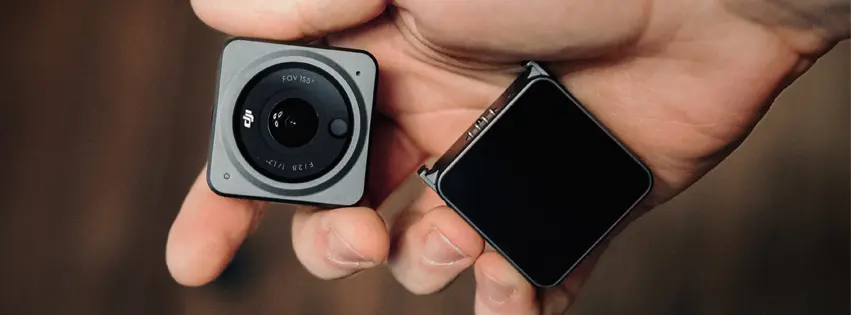
DJI is continuing its adventure camera developments and has created a new modular adventure camera solution called the DJI Action 2. Those in the know will notice that the “OSMO” has been dropped from the model name and the focus is now on modularity – different modules and accessories can be magnetically attached to the main body of the camera.
The camera module itself is small and square (39x39mm and 22mm deep) and contains a 12 MP camera sensor capable of recording 4K video. The lens provides a 155-degree field of view, and all activities can be easily monitored on the 1.76-inch OLED touchscreen, which is covered by tough Gorilla Glass. Magnets allow you to attach a second touchscreen module, an extra battery or a variety of different mounts to the main module, allowing you to mount the Action 2 on tripods, GoPro mounts or even wear it around your neck.
The Action 2 adventure camera has all the features that are now standard, such as electronic stabilisation, horizon straightening and the ability to record live or use as a webcam. It also has a built-in colour temperature sensor, which DJI says helps achieve better colours in more challenging lighting conditions and underwater.
DJI Action 2 is available in two bundles – Dual Screen Combo and Power Combo. Below we explain what’s included in the two bundles and how they differ.
- Touch-sensitive camera module
- Touch screen module
- Magnetic neck strap
- Camera mount with re-usable sticker and ball head
- Magnetic adapter fixing
- USB-C charging and connecting cable

- Touch-sensitive camera module
- Additional battery module
- Magnetic neck strap
- Magnetic adapter fixing
- USB-C charging and connecting cable

We also compare the DJI Action 2 to its predecessor, the DJI OSMO Action, and GoPro’s latest model, the Hero 10:
| GoPro Hero 10 | DJI Osmo Action | DJI Action 2 | |
| Video | 5.2K up to 60 fps | 4K up to 60fps | 4K up to 120 fps |
| Sensor | 1/2.3″ | 1/2.3″ CMOS | 1/1.7″ CMOS |
| video bitrate | max 100 Mbps | max 100 Mbps | max 130 Mbps |
| Waterproofing | up to 10 metres | up to 10 metres | up to 10 metres (only for chamber module) |
| Aegluup | 8x | 8x | 8x |
| Battery (operating time) | 76 min | 63 min | 70 min |
| Internal memory | none | none | 32GB |
| Memory card | MicroSD up to 512GB | MicroSD up to 256 GB | MicroSD up to 256 GB |
| Price | 529€ | EOL | 399€/509€ |
| Measurements | 71.8×50.8×33.6 mm / 158g | 65×42×35 mm / 124 g | 39×39×22.3mm / 56g |
| Magnetic fasteners | No | No | Yes |
In addition to the basic parameters above, we also highlight ten comparison moments between the DJI Action 2 VS GoPro Hero 10:
1. Resolution
In terms of standard settings, both cameras are actually quite close. Both cameras do 4K at up to 120fps and Full HD at up to 240fps. The GoPro Hero10, however, is also capable of 5.3K at 60fps, which scores a point in GoPro’s favour.
2. Colour reproduction
GoPro has added a new “Natural Colors” profile that reduces the brightness and contrast of colors. The DJI Action 2 has a built-in colour temperature sensor to help achieve more organic colours in more challenging lighting conditions and underwater.
3. Performance in low light
No adventure camera has ever stood out too much with low-light footage. This is usually because they have relatively small sensors. DJI has squeezed the Action 2’s slightly larger 1/1.7-inch sensor compared to GoPro’s standard 1/2.3-inch sensor – so the Action 2 performs slightly better in low light. The Action 2 also seems to maintain better stabilisation in low light.
4. Stabilisation
Both cameras upgraded their stabilisation systems: The Action 2 reached RockSteady 2.0 and the GoPro reached HyperSmooth 4.0. In terms of stabilisation, DJI RockSteady seems to have received a better upgrade, with the Action 2 creating a smoother image with the main units. The GoPro is great, but in some cases the image still feels jerkier. In addition, the Action 2’s horizon straightening feature is available without any additional accessories.
5. Audio sound
The GoPro Hero10 has a good built-in microphone system. To use the full microphone system of the DJI Action 2, an additional display module must be connected to the main module. Overall, GoPro seems to have more experience in this area and therefore offers better and cleaner sound.
6. Size and weight
A GoPro is still a GoPro – the same familiar size and shape as all the previous Hero series cameras. However, DJI has made the Action 2 modular and as a result, the main module is over 100g lighter than the GoPro and this can be an important consideration in some applications. Even with the extra module, the Action 2 is much more compact.
7. Memory capacity
The Action 2 camera module has 32 GB of internal memory, so it can hold around 30 minutes of 4K. The battery or display module has a MicroSD card slot, so you can add up to 256GB of MicroSD card. The GoPro allows for larger capacity MicroSD cards, but it doesn’t have internal memory – so both adventure cameras have their advantages depending on the situation.
8. Battery life
A GoPro will run for around 40-50 minutes on a single battery (at maximum resolution). Action 2 essentially doubles if you use the extra module – you’re looking at 2-3 hours. On the plus side, the GoPro has a battery swap option, which is a lot easier on the wallet than buying the Action 2 with the extra module.
9. Application
These cameras sometimes need to be connected to a mobile app, as their small size and control buttons can be difficult to use in some situations. DJI’s app is DJI Mimo, while GoPro’s is an app called Quik. The DJI app seems to be more user-friendly and gives you full control over all settings. GoPro has some concerns, especially for Android users.
10. Price
The DJI Action 2 Power Combo was 399€ and the Dual Screen Combo 509€ at the launch. The GoPro Hero10 has a full price of €529. DJI currently gives you more options for the same money.
Finally, who is Action 2 best for? In our eyes, it’s for the user who wants as few screws, frames and other bits and pieces as possible, and prefers a small and compact magnetic camera that’s more budget-friendly. Another target group would be FPV pilots, for whom weight is very important. Rent or buy and see for yourself!