
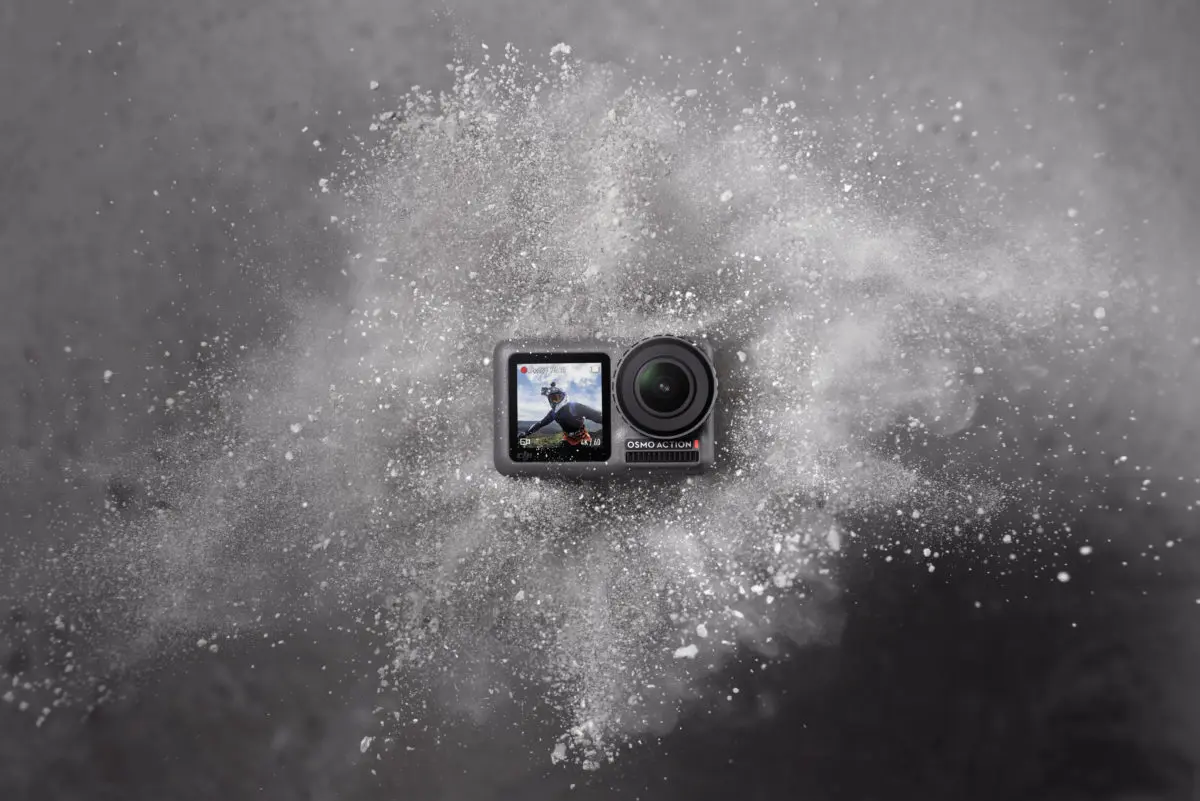
DJI unveiled yet another new product, but this time it wasn’t a drone or a gimbal-like gadget, but an adventure camera that offers direct competition to the GoPro. Very similar to the GoPro and called OSMO Action, it doesn’t look at first glance to be any different from the usual GoPro so-called ‘action’ cameras. At first glance, the GoPro doesn’t look like a Chinese copy of the GoPro, but when you take a closer look, there’s something in it that will make the biggest adventure camera manufacturer to date sweat.
When you take the OSMO Action out of the box, you’ll find the camera, battery, battery case, two mounting plates, camera sleeve and USB-C cable. DJI has tried to make the accessories as practical as possible. For example, the battery box also has a slot for a micro SD card and the mounts also fit GoPro accessories, meaning you don’t have to swap mounts when moving from GoPro to OSMO. You can see that they’re trying to be eye-catching with the attention to detail and sanding down the corners.
Screenshots

Moving on to the most noticeable thing first, the OSMO Actionis notable for its 2 screens – front and back. Both screens are colour and allow you to see the image from the camera, but only the rear screen is touchscreen – you can’t change settings from the front screen. The front screen makes framing or taking selfies extremely convenient, and to switch between screens you either have to tell the camera to “screen switch”, double tap the rear screen with two fingers, or hold down the QS button.
When changing settings on the rear screen, you’ll be surprised by the very responsive interface. With an emphasis on detail, the UI is well thought out and changing settings no longer feels nearly as frustrating as before.
Image quality

Using the sensor inside the DJI Mavic Air’s camera, the OSMO Action is capable of filming at bitrates of up to 100 Mbps, while retaining HDR. The timelapse can be filmed in 1080p mode at up to 240fps, or 8x slowdown. As you can see, in terms of video quality and options, the Osmo Action doesn’t lag behind its competitors. All the necessary components are there to film a family trip to Bali or the World Cross Country Championships. More detailed frame rate and resolution options are below:
4K (16:9) – 60, 50, 48, 30, 25, 24fps (RockSteady)
4K (4:3) – 30, 25, 24fps
2.7K (4:3) – 30, 25, 24fps (RockSteady)
2.7K (16:9) – 60, 50, 48, 30, 25, 24fps
1080p – 240, 200, 120, 100, 60, 50, 48, 30, 25, 24fps (RockSteady 60fps and below)
720p – 240, 200fps
Of course, OSMO Action also allows you to take pictures as well as video – with the choice of single, burst, time-lapse, time-lapse and shutter. Exposure (ISO and iris) is manually adjustable in photo and video modes.
The camera has a removable front filter/glass, which means you can use ND, polarised or UV filters, for example. At the time of writing this review, DJI has not yet launched its own filters, but third-party manufacturers already have them available.
RockSteady

What does ‘RockSteady’ mean? RockSteady (or RockStay) is DJI’s equivalent of the GoPro HyperSmooth. Simply put, it means electronic image stabilisation before recording video to a memory card. To put it more complicatedly, it takes a smaller image of the head of the sensor than the sensor would actually allow, and uses position sensors inside the camera to move the image within the overlay so that it appears more stable. RockSteady is slightly more stable than HyperSmooth, but it also involves a slightly larger ‘crop’, meaning that the sensor takes a smaller image and the angle of view remains narrower. Rocksteady can also be used in conjunction with a distortion compensation feature that removes the fish-eye effect from video. When used together, the video looks like a newer iPhone mounted on a stabilising gimbal, rather than an adventure camera shaking in the hand.
Waterproofing

The Osmo Action is waterproof to a depth of 11M, and there’s no need to put a transparent shell or other costume around the camera. However, waterproofing compromises on sound quality, as the microphones also need to be sealed. For this reason, it is possible to purchase an optional USB-C microphone adaptor to connect external microphones to the camera, but without an external microphone, the sound quality is on par with other waterproof adventure cameras.
If you don’t want to worry about the camera being exposed to water, the USB-C slot on the side is removable for easy insertion of various accessories.

In conclusion, DJI has come to the market with the first serious competitor to GoPro cameras. They have taken the knowledge and technology that has been tried and tested on drones and squeezed it into an adventure camera.
Not to mention the price. The Osmo Action costs no more and no less than 379€ and availability can be checked either by contacting Droon.ee or by coming to our Villard 22 showroom, where you’ll also have the chance to get your hands on a demo product and take a closer look for yourself.
A range of accessories and DJI Osmo Action Care Refresh insurance are available as standard.