
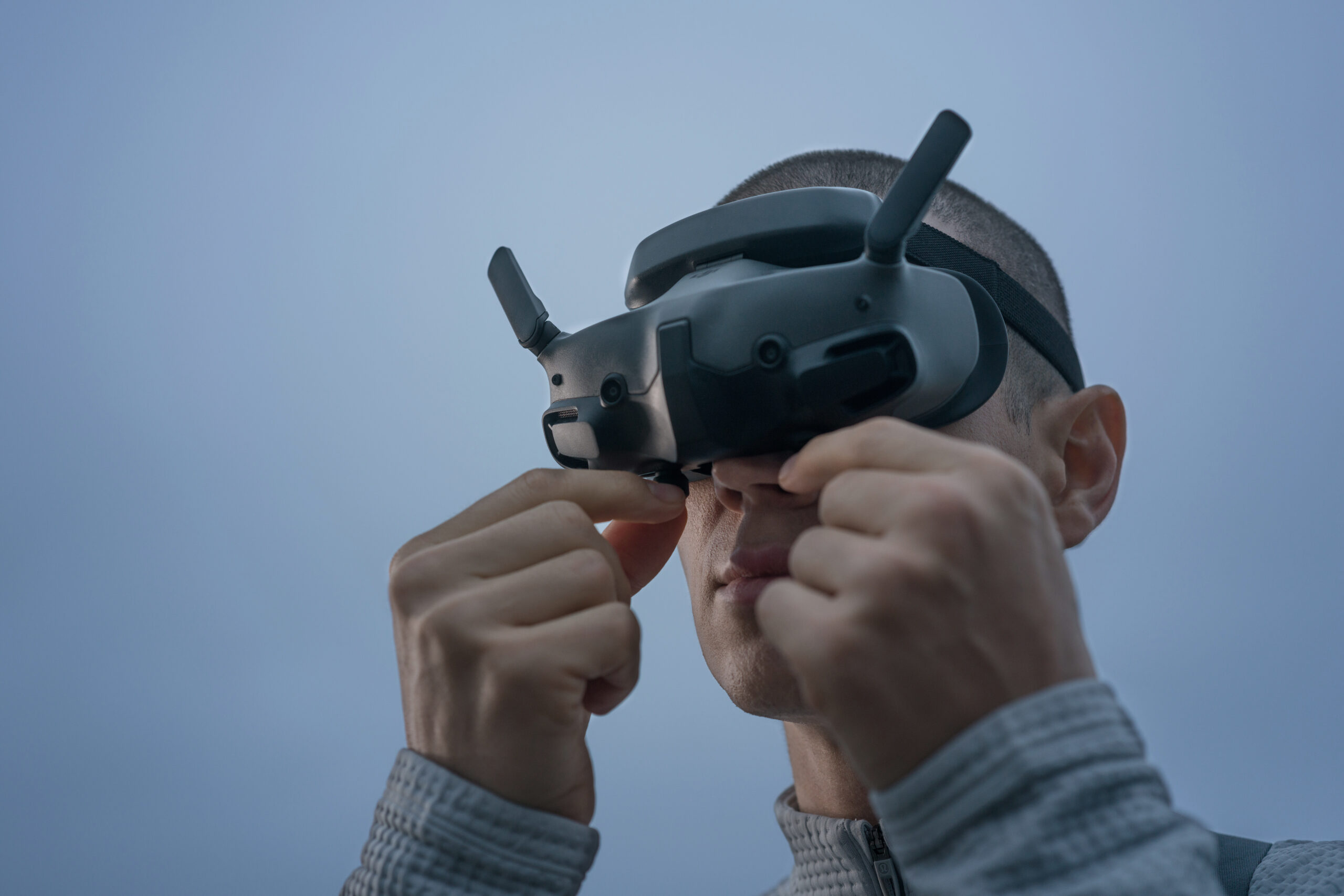
DJI Goggles 3 is DJI’s latest generation of FPV goggles, launched last year. While outwardly similar to the previous Goggles 2 model, a number of key innovations make the Goggles 3 a significant step forward. In this review, we’ll compare the two models, explain the key differences and help you decide whether it’s worth upgrading or sticking with the current model.
Technical data
| Feature | DJI Goggles 3 | DJI Goggles 2 |
| Screen size | 2 x 0.49″ OLED | 2 x 0.49″ OLED |
| Resolution | 1920×1080 | 1920×1080 |
| Refresh rate | 100Hz | 100Hz |
| Video transmission | 1080p @ 60/100fps | 1080p @ 60/100fps |
| Operating range (GHz) | 2.4 / 5.1 / 5.8 | 2.4 / 5.8 |
| Field of view (FOV) | 44° | 51° |
| Adjusting the screen size | 50-100% | 50-100% |
| Focus adjustment | -6.0 to +2.0 (lenses included to achieve -8.0) | -8.0 to +2.0 |
| IPD (interpupillary distance between the eyes) | 56-72 mm | 56-72 mm |
| Aku | Integrated (7.2V, 3000mAh) | External (2S 1800mAh) |
| Weight | 470g | 290g |
| Price (indicative) | 659 EUR | 599 EUR |
Design and ease of use
Goggles 3 has a new, more comfortable front – the goggles’ face contact no longer presses directly on the nose and eyes, but rests on the forehead. The result is a lighter and less tiring wearing experience, even during long flight sessions. The angle of view of the glasses can be adjusted to reduce light spill and achieve a tighter fit on the face.
An important change is the control system: instead of a touchscreen, there is now a physical joystick and button solution that makes menu navigation more precise and logical. A power button has also been added with a battery level indicator – a useful addition.
Although the antennas are foldable, they are no longer removable. This means that retrofittable antenna upgrades are not possible, which may be a disadvantage for some users.
Battery and power
Goggles 3 has a built-in battery conveniently located at the back of the head, similar to the helmet attachment. This solution makes it easier to use and eliminates the need for an external battery pack. The battery capacity (21.6Wh) is larger than that of the Goggles 2, but it also comes with a higher weight. The battery lasts up to three hours on a single charge and supports fast charging via USB-C (full charge in about 1-1.5 hours).
In addition, Goggles 3 also supports external USB-C power, which means you can use the battery bank for extended use if needed.
Image and focus
The screen size, resolution and refresh rate remain the same, but the difference is the field of view: the Goggles 2 offers 51°, while the Goggles 3 uses a narrower 44° field of view. Although numerically smaller, this is still a benefit according to many users – the wider field of view often led to blurry peripherals on the Goggles 2, so you had to reduce the view anyway. Goggles 3 offers a clearer and more in-focus viewing experience.
The focus adjustment range is smaller by default than the Goggles 2, but DJI has added -2.0 diopter lenses to compensate for this and allow for a similar user experience.
Real-time view and new features
One of the new features of Goggles 3 is Real-time Live View – two front-facing cameras allow you to see what’s happening without removing your glasses with a double tap. While the idea is a good one, its use is rather limited – the picture is 720p and the narrow field of view doesn’t add much value. A 3D view can also be used, as well as a Picture-in-Picture mode, where the live view and the drone image are displayed simultaneously.
OcuSync 4.0 – the new transmission system
The biggest technical leap in Goggles 3 is the new OcuSync 4.0 image and control signal transmission, which offers:
- lower latency (24ms vs previous 30ms),
- higher data speeds (60Mbps vs 50Mbps),
- greater coverage (up to 13 km vs 10 km).
OcuSync 4.0 is currently only available for Goggles 3, making these glasses much more future-proof than Goggles 2, which retains OcuSync 3.0.
Conclusion: which to choose?
If you’re already using Goggles 2 and fly predominantly with the DJI O3 system, an upgrade may not be necessary. But if you want the latest technology, longer flight times, better comfort and future O5 support, then the Goggles 3 is a solid choice.
Goggles 2 remain a good choice – especially if you can find them at a good price on the second ring. However, it should be noted that DJI is betting more on the newer model in the future, and it is the Goggles 3 that offers the best compatibility with the latest Air Units.