
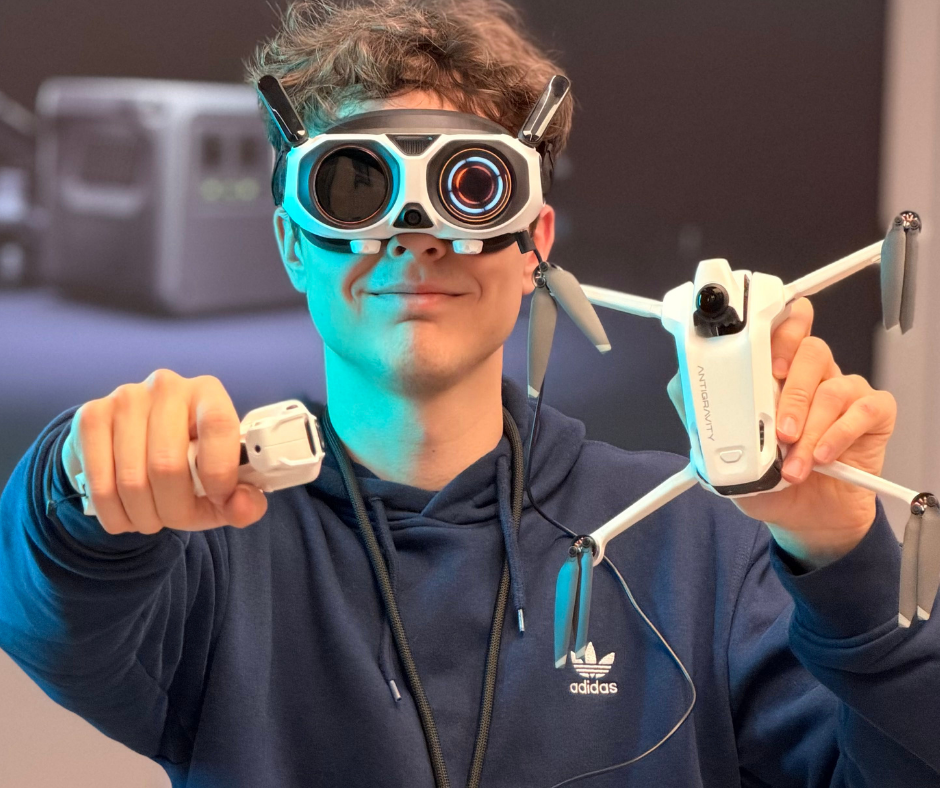
The Antigravity A1 is not just another new drone on the market. It doesn’t try to compete with classic camera drones just by offering better resolution or longer flight times. The A1 takes a different approach – it brings a 360° view to the flight experience and shifts some of the creative decision making from in-flight to post-flight.
It’s not just about how good the image quality is, but what kind of experience the drone creates and who it’s really for.
What is Antigravity A1?
The A1 is a 360° camera drone with two fish-eye lens cameras – one pointing up and one pointing down. The software combines them into one complete 360° sphere. This means that the entire surrounding environment is captured during the flight and the final frame is selected later in the montage.
Unlike a conventional gimbal drone, the pilot does not only see the “frame in front”, but can look around in goggles – up, down and to the sides – without the drone itself having to change direction. This makes the flying experience significantly different.
Design and construction
The A1 belongs to the sub-250 g class (standard battery), which makes it easier to use from a regulatory point of view and conveniently portable. The body is collapsible and the overall look is well thought out and finished.
An important detail is the lower 360° lens, which is the most vulnerable during landing. To protect it, the drone uses mechanical landing legs that are activated automatically. Given the real risk of scratching the lenses on 360° cameras, it makes sense that the manufacturer has also thought about their interchangeability.
It is not a drone that can withstand repeated violent impacts. It is more of a camera-centric system designed to provide a controlled and safe flying experience.
Goggles and a 360° flying experience
The A1’s biggest feature is Vision Goggles with real-time 360° views. With the help of head tracking, the pilot can look in different directions while the drone continues to fly along the selected trajectory.
The experience is surprisingly immersive on the first few flights. It’s reminiscent of a VR environment, but with a difference – it’s the real world.
The screen of the glasses is large and detailed, although due to the very wide field of view, there may be some slight softness at the edges. The centre remains clear and flight information is easy to read. Menus are accessed via the controller using the on-screen cursor, which works but isn’t always the quickest way to change settings.
Control and flight modes
The A1 uses a motion controlleror touch-sensitive control panel. Control is done by pointing your hand and pulling the trigger – the drone moves where you point it.
This makes the learning curve short and the system beginner-friendly. However, there is no traditional lever action or acro mode available. For FPV pilots used to full manual control, this may seem limiting.
Two main flight modes:
FreeMotion – the drone moves in the direction of the controller, while the pilot can look around freely.
FPV Mode – control is more through tilting, body rotation is not as necessary.
The flight is stabilised and smooth, but not designed for aggressive freestyle flying.
Flight qualities and communication
The light weight means that in stronger winds, the drone will reach its physical limits faster than heavier models. On a calm day, the flight is stable and controllable, but in windy conditions the maximum speed is reduced and stabilisation becomes more noticeable in the image.
Communication quality depends on the environment. In open areas the system works well, but between trees and obstacles the signal can weaken more quickly than on some drones with stronger transmission systems. Since this is not a high-speed FPV drone, latency is not critical, but it is more noticeable than in typical digital FPV systems.
Image quality and the 8K issue
The A1 records up to 8K 360° video. It’s important to understand that 8K stands for full sphere resolution. Cutting out a narrower frame of this footage will reduce the effective detail.
Wider views and closer subjects give the best results. In the social media format, the quality is usually perfectly adequate. However, if you expect the same detail as a large-sensor camera drone, you may be disappointed.
In low light, the image becomes softer and noisier, which is to be expected with a smaller sensor.
Post-processing and workflow
The strength of A1 is manifested in the assembly. The 360° material allows:
- subsequent selection of the cadre
- creating several different versions of one flight
- object tracking and dynamic framing
- export different aspect ratios from the same clip
If the user enjoys post-processing and wants creative flexibility, this is a big advantage. If the goal is to “film and get it done immediately”, the potential of this drone will be missed.
Battery and flight time
With a standard battery, the drone will stay in the sub-250g class and in real use you can expect around 16-20 minutes, depending on conditions. With a larger battery, the flight time increases significantly (26-35min), but the weight exceeds 250g.
The charging station allows you to recharge your batteries in series and also acts as a power bank for other devices when needed.
Who is this drone for?
Antigravity A1 is well suited for users who:
- creates social media or travel content
- wants several different shots from one flight
- appreciates 360° view during flight
- looking for a new and different flying experience
This is not an ideal choice for a user who:
- needs maximum detail in a classic shot
- wants acro mode and full manual control
- looking for a robust freestyle FPV platform
The Antigravity A1 is not a replacement for a traditional camera drone or a classic FPV platform. It creates a category of its own, where flight experience and post-processing flexibility are as important as technical numbers.
If you approach this drone with the right expectations – as a 360° tool, not a universal substitute – it is an interesting and potentially very valuable device for content creators.
If the Antigravity A1 sounds interesting to you, you can find the following kits in the drone.ee selection:
Insta360 Antigravity A1 Standard Bundle