
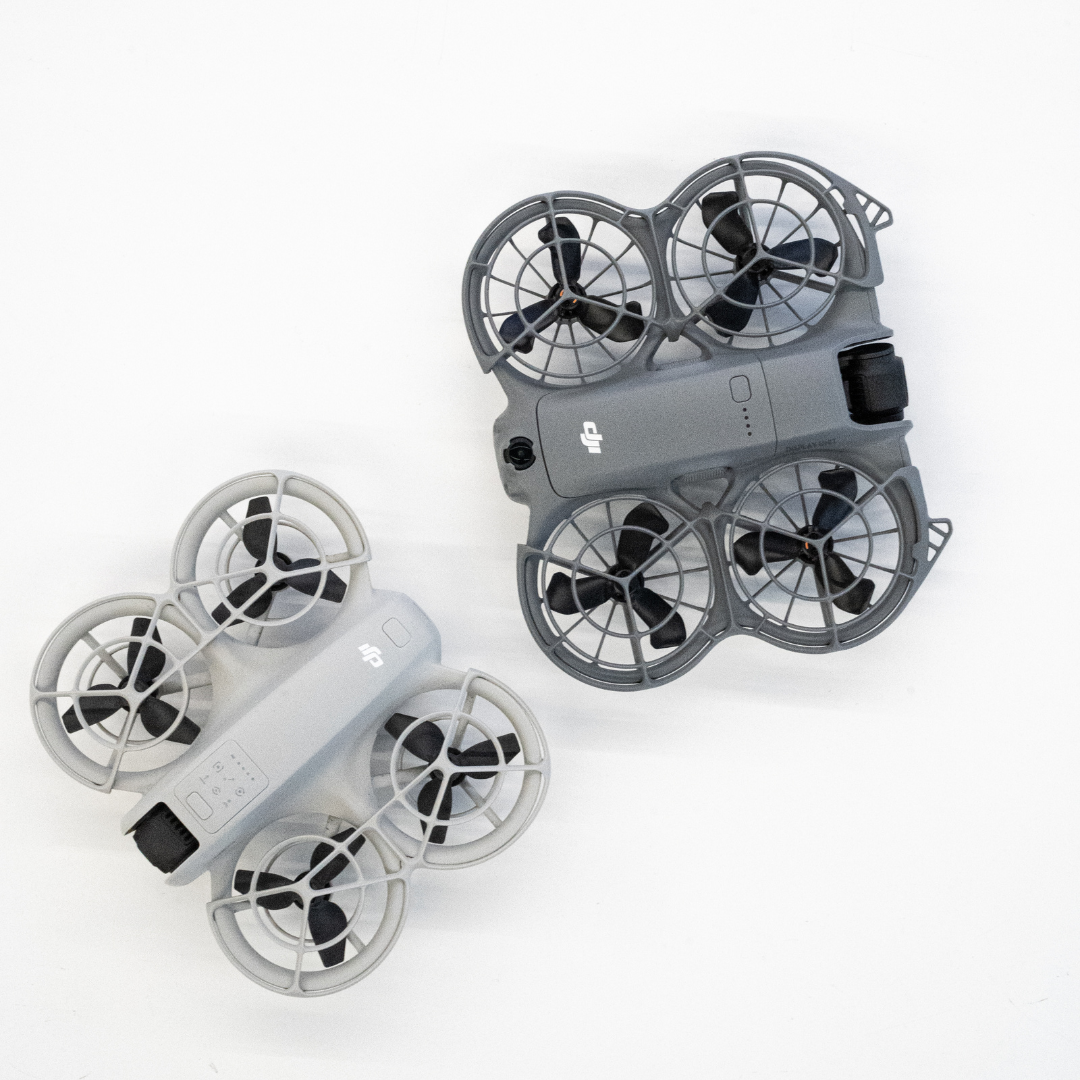
You know that feeling when a company gets a small product almost perfect – and then somehow manages to make it even better? That’s exactly what DJI did with the Neo 2. The DJI Neo changed the way we think of a pocket-sized drone – fun, friendly and surprisingly capable for its size. But the Neo 2 feels like DJI has taken every user feedback point and said: “Okay, let’s make it better.”
In this review, we’ll take an in-depth look at the differences between the DJI Neo 2 vs DJI Neo, explain what’s really changed, and discuss whether the upgrade is worth your attention or money.
Design and construction: compact but more confident
Both the DJI Neo and the Neo 2 remain true to DJI’s mini-a-capable design philosophy. The DJI Neo weighed around 135g, making it one of the lightest and most accessible drones for the beginner. It fit easily into a jacket pocket or small travel bag – perfect for spontaneous shots like sunset hikes or city rooftop views.
The DJI Neo 2 retains the same ultra-compact shape, but adds durability. It’s slightly heavier (150g), but the extra weight comes from stronger motors, a stiffer body and reinforced propeller guards.
On the ground, it gives much better stability, especially in windier conditions where the original Neo struggled a bit at times. The design also feels premium – more precise connection points and a cleaner finish give the Neo 2 a more professional feel, rather than a prototype.
Camera and gimbal: smoother, sharper, more cinematic.
This is where DJI has made the biggest leap. The DJI Neo recorded 4K 30fps videos with a 1/2-inch sensor and a single-axis gimbal – perfectly adequate for fast social media clips, but not ideal for dynamic motion or smooth panoramas.
Neo 2 changes the whole experience. While the sensor size is the same, DJI has improved the optics and image processing – with richer detail, better dynamic range and stronger low-light performance.
Most importantly: a new two-axis gimbal. This means the horizon stays perfectly straight, even in rotations or diagonal movements. Combined with 4K 60fps video, you get film-quality smooth shots and the option to shoot in slow motion.
Colours are more vibrant, skin tones more natural and light/dark areas better balanced. For travel bloggers and content creators, the DJI Neo 2 delivers cinematic quality straight from the drone – no post-processing required.
Flight performance: more stable and confident
In flight, both drones are nimble and accurate, but the Neo 2 adds an extra layer of confidence. Upgraded motors and algorithms allow for better position holding and wind resistance. The original Neo was light and fun, but a bit jumpy in windy conditions. Neo 2 is calmer, smoother and more stable.
The controls are more intuitive and responsive – making flying with the Neo 2 truly enjoyable, whether you’re tracking a moving object or practicing creative flight trajectories.
Identification and safety: smarter and safer
This is one of the most impressive innovations. The original Neo had only basic downward-facing sensors, suitable for take-off and landing. The Neo 2 now offers ambient sensing – front, bottom and sides.
It detects obstacles earlier, adapts its flight path and avoids collisions automatically. Whether it’s in the woods or in tight spots in the city, Neo 2 gives you much more confidence.
It’s not yet on the level of the top DJI Mavic models, but it’s a big step forward in the mini drone category. Video transmission is better too – cleaner and more stable images even in areas with interference.
Storage and connectivity: double the capacity
Another practical update: internal memory increased from 22 GB to 49 GB. This allows you to capture more 4K shots without worrying about space or having to swap memory cards mid-flight.
This makes Neo 2 the ideal travel companion for spontaneous shooting and filming.
Smart features and app experience
Functionality was already strong with Neo – gesture control, palm start and subject tracking. With Neo 2, everything is even smoother and faster. Gestures are instantaneous, voice control is more precise and Follow Me keeps track of the subject, even in the case of irregular movements.
The app’s interface is cleaner, tutorials load faster and connection setup is almost instantaneous. These innovations make flying less technical and much more creative.
Battery life and charging
Battery life is similar for both models – 18-19 minutes on average. However, the Neo 2 uses power more efficiently, giving a slightly longer real flight time in active shooting. It recharges faster and the battery stays cooler during consecutive flights – ideal for content creators filming multiple takes outdoors.
Final conclusion: a mini-drone that looks professional
The DJI Neo 2 doesn’t reinvent the mini drone – it improves it. It’s more stable, smarter and more cinematic, solving almost all of the original Neo’s shortcomings while retaining a pocket-friendly form factor and take-anywhere energy.
If you’re filming travel vlogs, urban clips or creative scenes on the move, the DJI Neo 2 is one of the best mini drones you can buy today.
Find out more in our e-shop or visit our store at Villardi 22, Tallinn.