
Who is Kaupo Kalda?
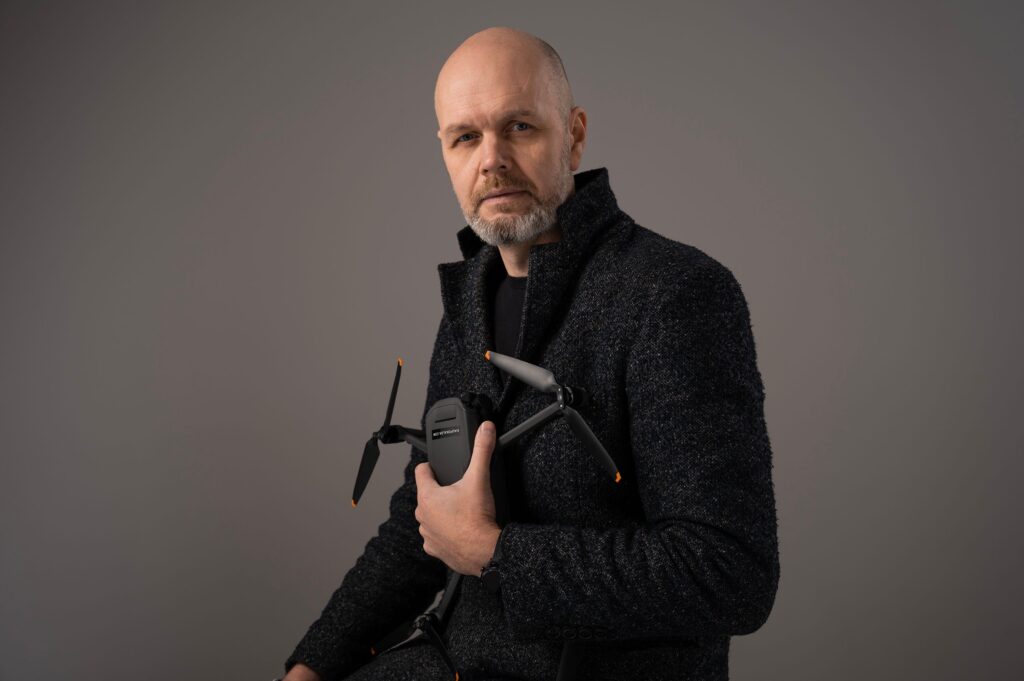
Kaupo Kalda is a native of Tallinn, whose career as a UX designer has spanned over twenty years. He started out running an agency, but more recently he has been freelancing. Over the last 11 years, his professional journey has taken an exciting turn thanks to his involvement in drone photography, which has enriched his work significantly. While in winter Kaupo concentrates more on design, in summer photography dominates.
Early days: interest in drones
Kaupo’s interest in drones started in 2014 when he visited a relative who owned a Parrot drone. When he first encountered this new technology, he was deeply curious. At the time, drones were still in their infancy in Estonia, generating much excitement. Being known as an early adopter, Kaupo quickly grasped the possibilities of drone photography, which helped him quickly make a name for himself in the field.
First drone and lessons learned
“My drone adventures started with a Parrot drone, but soon after I discovered the DJI Phantom 2 Vision,” Kaupo explained. This drone was equipped with a gimbal, which at the time was the latest technology. “The first flights were clumsy, but soon I started offering drone flights as a service.”
Kaupo learnt to fly in the open spaces of his seaside home, where there was plenty of room for error. “In the beginning, information was scarce and a lot had to be experimented with. YouTube was a big help, but once I almost flew a drone in my face,” he recalled. “I just looked at the screen and didn’t notice the drone approaching me. Luckily I was able to react at the last moment.”
His early experiences with drones were full of lessons learned. “Older drones often lost their signal or behaved erratically. There weren’t a lot of rules in the beginning either, the drone felt more like a toy.”
Over the years, Kaupo has been dedicated to explaining the rules of drone flying and ensuring safety, especially in urban environments. “The rules are important, especially here in Tallinn, where the airport is located right on the outskirts of the city. They help to keep everyone safe,” Kaupo stresses.
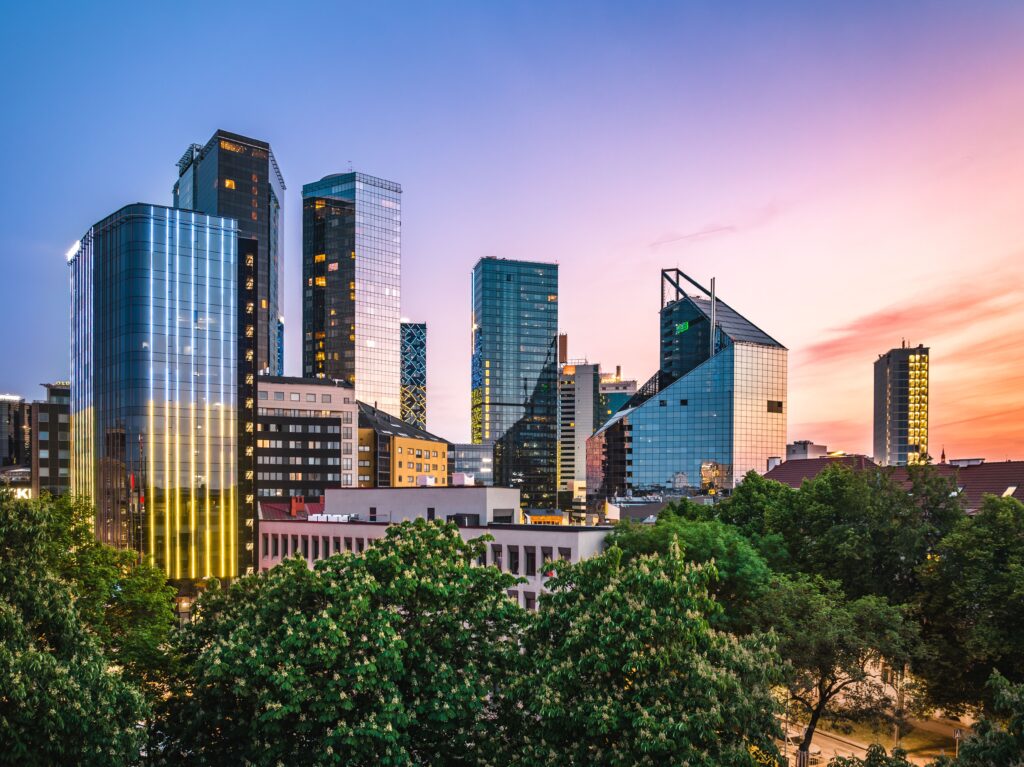
Do you prefer to take pictures, film or just fly with a drone? Why? “For me, a drone is first and foremost a flying camera that gives you the freedom to use the whole space,” Kaupo explained. He has been a photographer since he was eight years old and prefers to shoot mainly with a drone – whether it’s architecture for work or nature and the Old Town as a hobby. “Filming requires moving sideways, which makes flying more dangerous as you can’t see out of the way. That’s why I stick to photography, where I can calmly adjust the composition.”
When shooting with a drone, comfort is important: “In the winter, I can sit in a warm car with a tea-top in my hand and calmly adjust my image on the screen. This speeds up the pace of the work, although sometimes I’ll go to the same spot several times to find the best angles and light.”
Memorable moments
“The most memorable flights are the ones that get your adrenaline pumping, like when you lose your drone,” Kaupo begins. He has lost drones into the sea in his drone flying career and once even got run over by a car out of distraction, although fortunately there have been few such incidents.
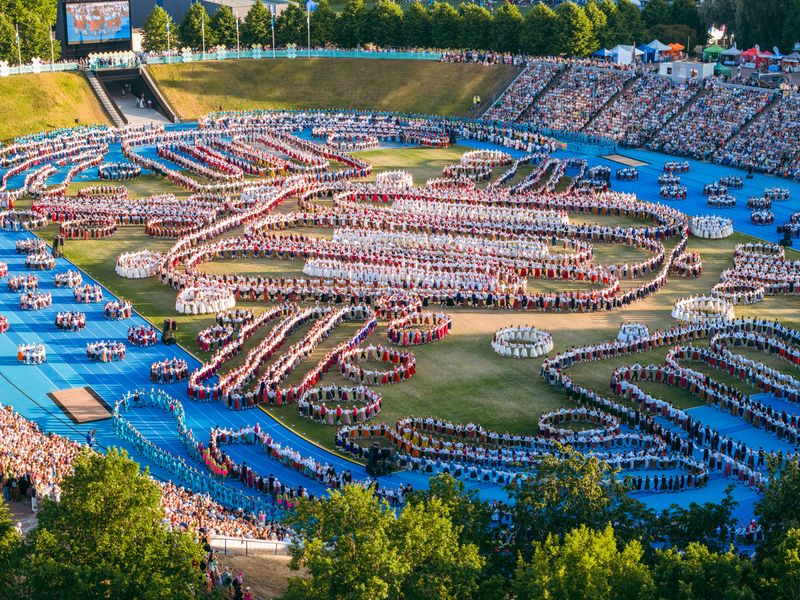
One particularly lively flight was the 2023 Dance Festival. “You look at the screen and the corner of your eye is wet because the sight is so beautiful and you feel proud to be part of it and to record it,” he recalled. “Then the tour and the emotions on the ground – very memorable.”
Kaupo also highlights ship shootings, where the action takes place at high speed and in a matter of minutes. “I’m also reminded of the large factories, which are impressive in their colossality and photogenic quality, but also a little eerie.”
Favourite spots and challenges
“If you think of a drone as a flying camera, photographers don’t usually reveal their favourite spots,” explained Kaupo. He notes that while he is not particularly secretive about his favourite spots, and the image bank on his website often shows where a photo has been taken, he doesn’t explicitly name any spot as a favourite.
“But if you look at the place where I’ve taken the most pictures, it’s the Old Town of Tallinn.” he continued. “There are endless opportunities to explore and travel through time, like a time machine through the centuries. Maybe there will even be a book about it.”
Technique used
“My current favourite is definitely the Dji Mavic 3 Pro,” Kaupo confirmed. “It’s the best choice for a photographer today, although the Dji Inspire 3 is technically even better.” In his opinion, the Inspire model is too big, dangerous and noisy for everyday urban flying, which, in addition to legal restrictions, makes it too expensive for our photography market.
“But the Mavic 3 Pro is just right – small, light, quite quiet, and the strength of it is that it is equipped with three cameras: 24mm, 70mm and 166mm lenses,” Kaupo said. He admits that he rarely uses the 166mm lens because its performance is weaker, especially when it comes to colour rendition. “But I wouldn’t imagine my life without a 70mm lens, because about half of the pictures I take are with that lens.”
He hopes that the next model will pay particular attention to the development of TV cameras. “The main camera is already pretty good and there’s not going to be a big leap there. I hope to see a new model as early as this year.”
Advice for beginner drone pilots
Kaupo points out that general photography basics are important when creating good shots: “Visual creation is a broader topic, whether it’s a drone, a camera or a phone. With the drone, unlike in the early days, it’s no longer just about novelty; the quality has to be top-notch, just like any other photography. It’s about light, composition and post-processing.”
“A drone photo doesn’t necessarily mean a very high view, but rather the use of free space. Too high up and the picture often loses its interest. Mostly I use a drone to shoot from human eye level or from five to six metres. Higher up you can get the context, but closer up you capture the details of the object itself,” he adds.
“It is important to know and follow the rules of the air, avoid exceeding speed limits, and not fly over human masses or near airports.” He also shares a personal tip: “I always take off and land with the back of the drone facing towards me, so that I can react quickly and in the right direction in unexpected situations, such as wind gusts or a dog in front of me. If the ‘nose’ of the drone is towards you, the steering is in a mirror image and this can be confusing,” Kaupo stressed the importance of knowing the rules.
(Photos from private collection)