
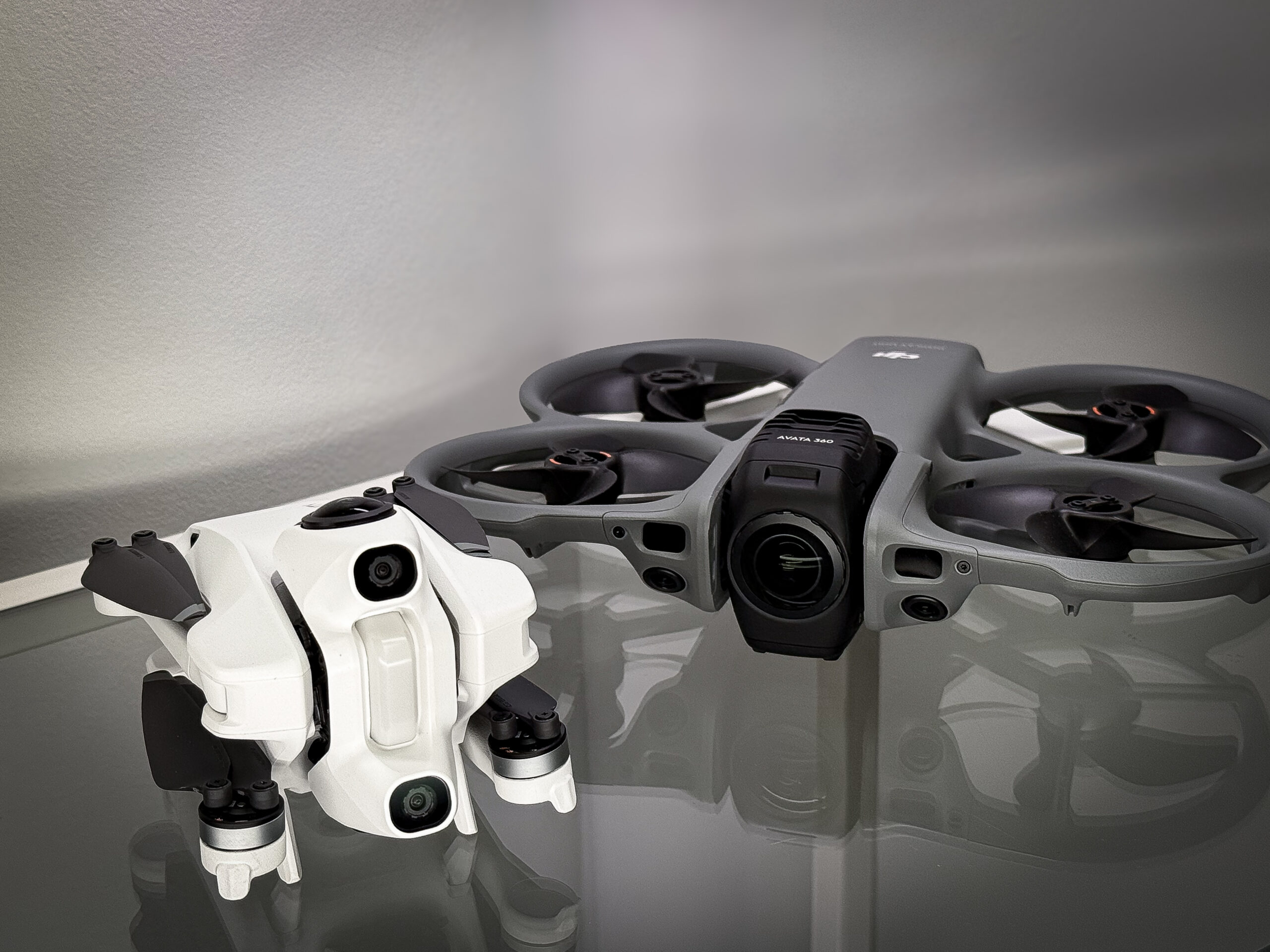
The world’s first two 360° drones – but which one is actually better?
The drone world saw a significant shift at the end of 2025. Until then, 360° cameras and drones had existed as separate categories, and while they could be combined, the result had never been a truly integrated or user-friendly solution.
Then came the Antigravity A1 – a compact drone weighing under 250 grams with a built-in 360° camera system. Its main idea was simple: fly first and choose your shots later.
DJI responded quickly and launched its first drone specifically designed for 360° filming in March 2026 – the DJI Avata 360. Although both devices belong to the same new category, their approach is very different.
Put the two drones side by side, and it quickly becomes clear that there are more differences than similarities.
Price and availability
Price is one of the biggest differences between the two. DJI Avata 360 is available in Estonia from approximately €719, while Fly More bundles are priced at around €939. Antigravity A1 bundles, on the other hand, start at approximately €1,399 and go up to €1,699.
This means the Antigravity A1 is realistically almost twice as expensive, and in some cases even more. Considering that DJI also offers better technical specifications in several areas, the price difference is one of the strongest arguments in favor of the Avata 360.
Design and build quality
From a design perspective, these are two completely different philosophies. Antigravity A1 is built to be as compact and lightweight as possible. Its foldable arms make it easy to transport, and its weight remains under 250 grams, which means more relaxed flight regulations in many countries.
DJI Avata 360, on the other hand, is larger and heavier, weighing around 455 grams. It is not foldable, but it features integrated propeller guards and feels noticeably more robust. The construction is more aerodynamic and designed to handle more demanding situations.
In practical use, this means Avata 360 can better withstand minor impacts, while the A1 feels more delicate and requires more careful handling.
Camera and image quality
Although both drones record 8K 360° video, there is a clear difference in quality. DJI Avata 360 uses larger sensors and can record up to 8K at 60 frames per second, while the Antigravity A1 is limited to 30 frames per second.
DJI also supports 10-bit video and a D-Log color profile, providing significantly more flexibility in color grading. Antigravity A1 uses a simpler 8-bit image, with more limited post-processing options.
In real-world use, this means one thing: Avata 360 footage is sharper, cleaner and offers better dynamic range. Stitching – the process of combining the images from the two cameras – is also smoother on DJI.
For photos, Avata 360 offers a maximum resolution of up to 120 megapixels, while the A1 delivers roughly half that resolution.
Editing and workflow
The biggest value of 360 drones is not only in filming, but also in what happens after the flight. Both manufacturers provide software that allows you to choose different viewing angles from the 360 footage and create a traditional video.
The workflow is similar. The footage is imported, camera movement and key angles are defined, and the software then creates a smooth video based on them. Automatic editing options are also available.
This means a single flight can be turned into several different shots and formats, making 360 drones a very powerful tool for social media and marketing content.
Safety and flight assistance systems
In terms of safety, DJI is clearly ahead. In addition to visual sensors, Avata 360 uses LiDAR technology and offers 360-degree obstacle detection. Antigravity A1 sensors only cover the front and downward-facing areas of the drone.
Avata 360 also has built-in propeller guards, providing additional confidence when flying in tighter environments.
Both drones offer automatic takeoff, landing and GPS-based Return-to-Home, while battery life is around 20 minutes on both. Antigravity A1 is also available with higher-capacity batteries, but in that configuration its weight exceeds the 250 g limit.
Flight experience and controls
DJI Avata 360 offers two control options. It can be flown with a traditional remote controller or with FPV goggles and a motion controller. This gives the user more flexibility and also makes it possible to fly without a companion.
Antigravity A1 works only in FPV mode, meaning it always requires goggles and, when following regulations, also another person to maintain visual observation of the drone.
In terms of flight characteristics, Avata 360 is faster, more precise and more responsive. The A1 feels calmer and slower, which may suit beginners but limits the creation of more dynamic content.
Noise level
DJI Avata 360 is noticeably louder than the Antigravity A1. Although the numerical difference is not particularly large, the sound is clearly stronger in real-world use.
Conclusion
Antigravity A1 was the first drone to bring a fully integrated 360° camera system into the drone world. It was an important step and an innovation that helped move the entire category forward.
DJI Avata 360 takes that idea and pushes it to the next level. It offers better image quality, more features, greater safety and significantly better value for money.
Tests and comparisons clearly show that Avata 360 is currently the most complete 360 drone on the market and offers more for both content creators and everyday users.
If the goal is to create high-quality and flexible content, DJI Avata 360 is currently the stronger option.