
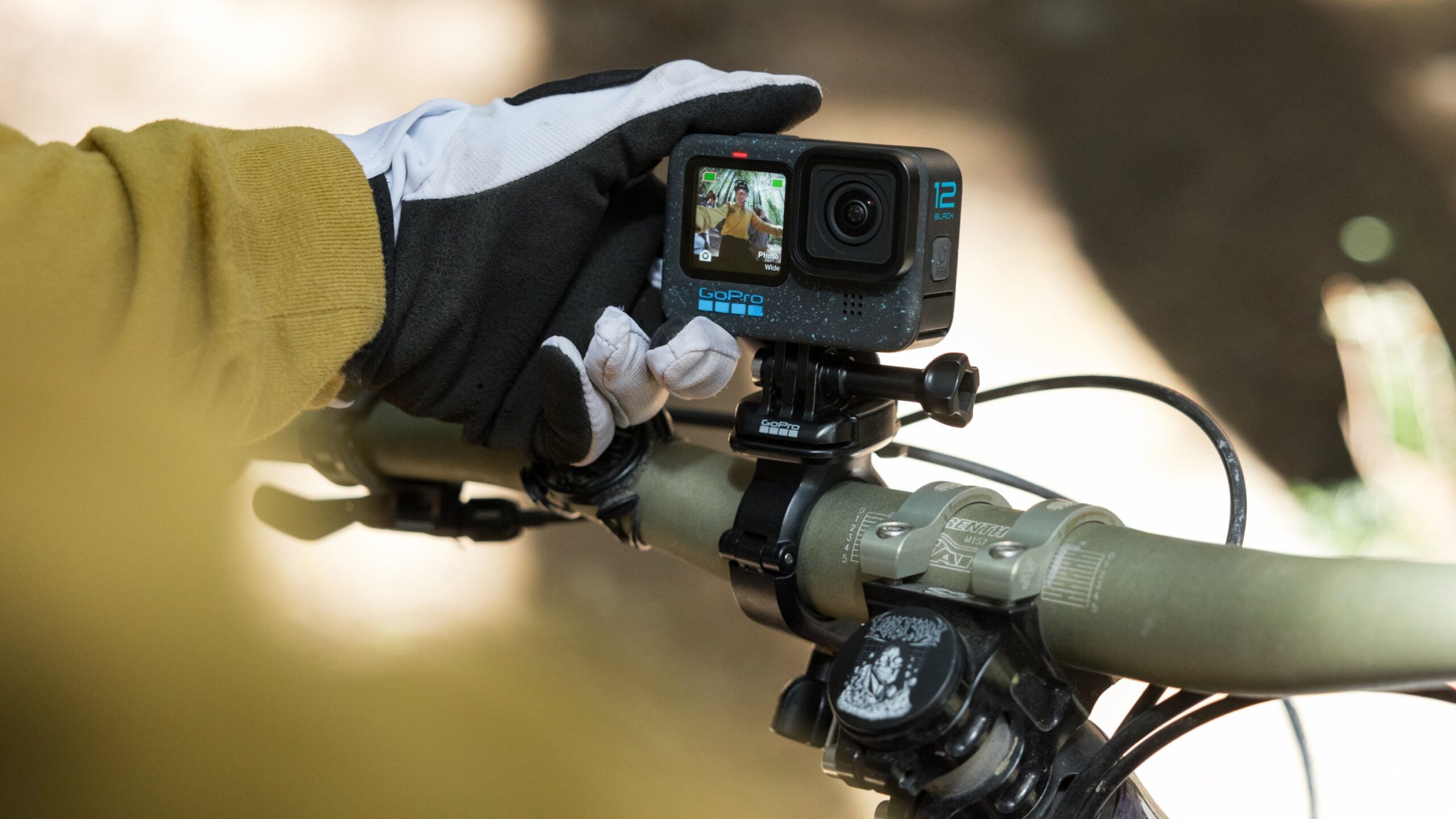
A GoPro is like an iPhone, every person has come into contact with one, owned one or heard of one in some way.
Some have it, some have several. But is it worth replacing a new model with an older one? Here we take a look at the new Hero12 to see if it’s better than its predecessor and whether it’s worth upgrading.
GoPro Hero adventure cameras can survive the most extreme conditions in the mountains and on the water, as well as a small tourist trip in a big city. Even the most tech-savvy can handle this camera. As well as being extremely popular, there’s a good reason why they are so: high quality inside and out, and capable of producing incredibly good footage in such a small and compact package.
It is no longer a trendy product but is here to stay. The 12th generation is already proving that it has successfully survived in a world of constant technological change.
The company was founded in 2002 and the first digital adventure camera that we know of was released in 2006 (the years 2002-2006 saw the world’s first 35mm film camera).
We picked up a GoPro Hero3 for the first time and it’s 2011 – as you can see, it’s still close to our hearts, being a staple in our shop (along with a wide range of accessories).
Now that the latest release has been unveiled, we’ve been spinning it around for a few months as well as putting it to work, while also carefully renting it. So we have the experience ourselves as well as the customer feedback, which we’re neatly collating here. And we do it honestly, without embellishment.
Latest features
The new updates to the latest GoPro Hero12 are quite good, but not so great as to overshadow the Hero11.
- Doubled battery life
- HDR video
- GP-Log image profile
- HyperSmooth 6.0 + 360 degree horizon lock
- Network-free audio support
- Vertical recording mode
- Interval photo mode
- Max Lens Mod 2.0 compatibility
And all the same features that are available on the Hero11:
- 1/1.9″ sensor
- 8:7 aspect ratio
- 10-Bit colour profile
- 5.3K 60fps
- 4K 120fps
- 2.7K 240fps for 8x slo-mo images
- 27 megapixel photos
- 33 feet (10m) waterproof directly out of the enclosure (without additional enclosure)
- Voice control and voice commands
- LCD full colour front screen
- LCD full colour rear screen
- RAW images in all modes
Double battery life
The biggest innovation with the Hero12 is that somehow they’ve managed to squeeze a lot more juice into the already familiar Enduro batteries. Maybe the same battery – longer life. As much as 2x more! They were able to do this with a software update to the battery management system, without the need to upgrade or upgrade the battery. Longer battery life means more adventure without worries, and less batteries to carry, which makes the life of any backpacker very comfortable.
But what are the numbers? At 5.3K60fps (which is the maximum video resolution), you can film for 70 minutes in a row (Hero11 was 35 minutes). By lowering the resolution a bit to 5.2K30fps, you can go from 70 minutes to 95 minutes. However, if you take the most common resolution typically used by the average person – 1080p30fps – you can record a whopping 155 minutes in a row.
But is it just on paper or is it in reality? We went outdoors, the snow wasn’t on the ground yet, but it was quite wet and damp – 4K60fps, with full stabilisation and we clicked pictures too – in 30 minutes of footage we got 60% of battery power used up. So, 40% or so of the 15 minutes of footage could still have been done. This is actually more than enough, as only a few clips were used (about 1-2 minutes). Yes, all of this could have been done with the Hero11 or another older model, but there was always a spare battery in the pocket. With the Hero12, you don’t need to carry a spare battery directly. Since Enduro batteries are designed for colder climates, I didn’t have to worry about suddenly running out of battery due to weather conditions.
High Dynamic Range (HDR) video
High Dynamic Range (HDR) is a method of capturing fine detail and colour in a wide spectrum of light, while keeping images as realistic as possible. What is it good for? Still, to make the video image as instantly striking and beautiful as possible, without having to go to a lot of trouble in post-processing.
GoPro introduced HDR photos in its settings a long time ago to make photos really shine. But now, with the Hero12, it’s made its way into video, available in all resolutions including 5.3K and 4K.
It’s also one of the new features that our customers are very excited about.
Max Lens Mod 2.0
Along with the Hero12, the Max Lens Mod 2.0 was also unveiled as an addition to the already well-known GoPro wide lens accessory. How does it work? You attach this lens to the lens attached to your camera (you twist the glass away from the front), and then with the touch of a button in the settings you can get a 36% wider image (widescreen) in video and 48% longer in vertical video. It also gives you a 177° view at 4K60fps video and activates the horizon lock. If you want to capture footage of any adventure that requires a wider picture, such as motorsport or skiing, this lens is a great tool. However, if you’re filming everyday, everyday action, then this wide-angle lens isn’t exactly the gadget you need.
HyperSmooth 6.0 with horizon lock
The Emmy award-winning HyperSmooth video stabilisation first introduced on the Hero7 has also now received an update. HyperSmooth 6.0 should be even better and more stable than its predecessor. But is the new one noticeably more different from the old? No, we can’t tell the difference. So the Hero11 is just as stable as the Hero12. Surely there’s someone for whom it’s better. That’s good enough – because it’s still a very good stabilizer, there’s nothing to complain about.
GP-Log image profile
If you’re a professional videographer and you like to make colour corrections, you’ll know how important it is to have a full colour profile in log format (DJI D-log, GoPro GP-log, etc). Now with the Hero12, you have the option to turn on the log and have full control over what the final result of your footage is. GB-Log is particularly useful if you want consistent footage using an adventure camera, a drone or a mirror/hybrid camera.
Time code synchronisation
Again, something for the pros: Sync an unlimited number of GoPro HERO 12 Black cameras to a single timecode to make editing in Final Cut Pro or Adobe Premiere super-easy.
Network-free audio support
Again, especially for the pros: the GoPro hero12 has a Bluetooth-enabled audio system, which means you can listen to the audio in real time with headphones that are offline. Ideal for recording interviews, vlogs or music/dance shows, for example.
Vertical recording mode
Let’s face it, in 2023, everyone, including your grandma, will be filming vertically rather than horizontally – because it’s the most common form of social media (and it’s also handy to have your phone handy when you need to record something quickly). Social media has changed the way we view things, so everything is in 9:16 rather than the traditional 16:9 or 4:3 – whether it’s TikTok content, Instagram reels or Facebook stories. But what happens when you want to put that same content on YouTube or send it to your friends and family? GoPro came out with an 8:7 sensor, which means you can capture video and then crop it to the format you want with just a few clicks. No matter how you have your camera mounted – vertically or horizontally – you can produce content for all the platforms you want, at the size that suits them, without losing quality. One downside, though – you can’t access this feature in Pro settings.
1/4-20 tripod socket
It’s the most common thing that’s rather required in photo-video shooting – now also on the Hero12. The usual familiar ‘ears’ mount has been retained as well as the addition of a 1/4-20 tripod mount, which is the most universal and compatible with all standard tripods. A little feature that will make a lot of videographers very happy.
Summary
If you don’t already own a GoPro Hero adventure camera, but your heart desires one – we recommend the hero12 model. However, if you do have a predecessor in the form of the hero11, there has been little evolution and I see no reason to upgrade to a newer model. However, if you have the option, the newer camera model will certainly offer a lot of rewards – especially in terms of long battery life.
What we have noticed most about the new model (the positives):
- the camera hasn’t yet “locked up”, on the previous model we noticed it often. However, it seems that this minor bug has now been fixed.
- the battery lasts figuratively forever 🙂
- The menu is simple and easy to navigate.
- The body of the camera has blue dots on it – if you have several (hero10/11) cameras, you’ll be able to tell one from the other.
Which we don’t like very much:
- Lack of optical or digital zoom
- larger sensor
- audio quality could be a bit better but if you’re a hobbyist, it’s not a big deal to dwell on