
Insta360 has been working for years to connect the world of 360° video with the conventional adventure camera. The first Insta360 One RS was designed with interchangeable camera modules to allow this flexibility. In reality, however, lens swapping is an activity that takes time – while adventuring it’s probably not the most practical solution.
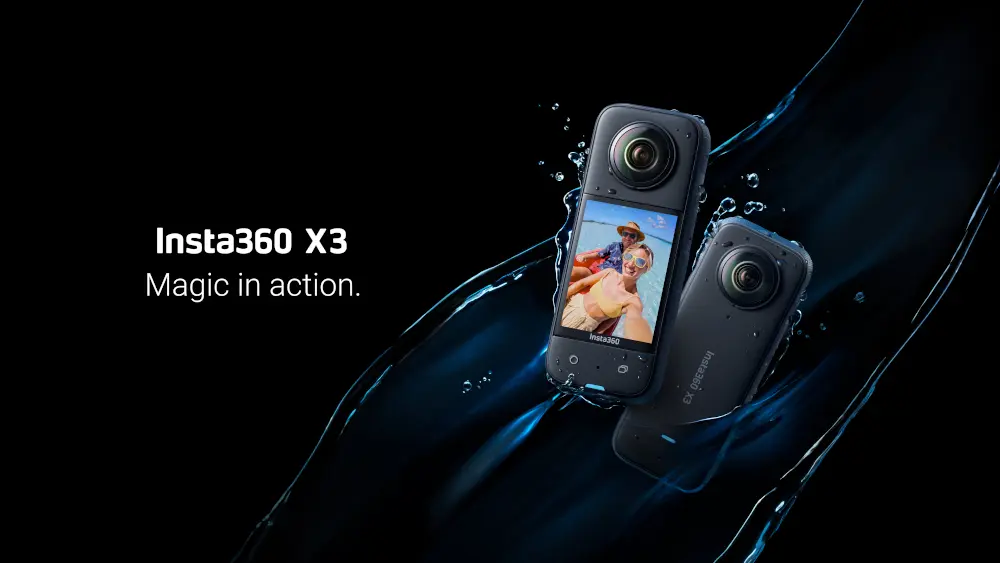
The new Insta360 X3 is the successor to the Insta360 One X2, with the name tweaked and the word “One” removed. The main feature of the camera is still the 360° camera, but with the addition of the ability to use only one side of the camera and capture decent 4K footage with a standard adventure camera view. It’s ideal for 360° enthusiasts who want to capture the occasional simple adventure shot.
What’s new?
Although the X3 looks similar to the X2, there are also some updates. The first example is the addition of physical buttons. Two of them are located under the screen – one for starting and stopping recording, and the other for switching between 360° and normal mode. On the side, there’s a power button and a quick menu button for quickly switching between presets. The X3’s screen is much larger (2.29″ vs 1″) and brighter, making it easier to use in direct sunlight. The battery hatch and SD slot cover are also better sealed, and a proper seal ensures water resistance up to 10 metres.
The new 1800mAh battery ensures longer battery life. We managed to record in 4K resolution for over 1.5 hours on a single battery. Insta360 claims you can film for an average of 81 minutes at 30fps and 5.7K resolution, which seems achievable based on our testing. It’s worth noting that the larger battery and a few other changes make the X3 a little heavier, but ultimately it’s comfortable to carry and doesn’t tire the hand too much.

Video specifications are 5.7K at 30 frames per second in 360° mode, the same as its predecessor. However, the larger 48-megapixel half-inch sensor and wider aperture lens make the X3’s video output significantly better than the X2’s.
The X3 also introduces the aforementioned ability to choose between modes – either recording 360° video through both cameras, or using just one camera to capture traditional 4K video. It’s worth mentioning that the frame rate is limited to 30 FPS with one camera. This certainly adds value to the X3 and makes it more competitive with Insta360’s own One RS system.
Keep in mind that while the video quality is impressive, the 5.7K resolution across the entire spherical scene is not as sharp when diffused as one with a traditional wide angle lens covering approximately 160 degrees. When viewing the footage in the Insta360 app (or any other 360° video viewer) the difference is barely noticeable, but when exporting the video to a traditional ‘flat’ format, you get 1920×1080 – to export 4K resolution video you’d need to capture 360° at 12K resolution. If you want to test the maximum resolution, the X3 is also capable of capturing 8K timelapse video, which looks amazing even when exported in flat format.
As we’ve noted with other Insta360 cameras, the FlowState’s stabilisation is on par with anything else on the market, including GoPro. When switching to 360°, there’s sometimes a slightly shiny effect, especially around the ‘seams’ of the video, but it’s not difficult to minimise so that the main subject remains in the centre.
However, this model is not just for video, as it is also capable of capturing spherical 72-megapixel images with impressive detail. Posting to social media channels does lose that detail, but it’s a cool feature to try out. We had a lot of fun using it for street photography type shots. The timer button on the end of the selfie stick was a helpful tool. Later on, the Insta360 app can automatically turn those photos into animated panoramas.
The app ensures mobility
As with other Insta360 cameras, the X3 is also compatible with the Insta360 app. The Insta360 app remains one of the best and most user-friendly we’ve used. Yes – it’s not exactly Final Cut Pro, but for an app that works on your phone and for fast processing, it’s impressive.
If you don’t have a clue what to do with the footage you’ve saved, the in-app tutorials will help you think of key frames, cuts and other changes. It’s these tutorials that stand out most in the app. Even if you don’t have an Insta360 camera, it’s worth browsing the app for tips alone. There are also some automated editing tools available in the app, which are fun to play with. For those who want to edit their adventures away from their phone, Insta360 also offers a desktop-based app for Mac and Windows.

Mobile View
(on your device)

Computer view (on Mac)
Summary
If we hadn’t recently tested the Insta360 One RS 1″ 360°Edition, we’d be prepared to say that the X3 produces the best 360° video on the market today. However, the One RS 1″ 360 Edition offers better video results thanks to its excellent sensor and Leica lens. Compared to the X3, however, it’s more than twice as expensive, significantly heavier, partially waterproof and therefore less comfortable for adventures. If you’re interested in 360° video, the Insta360 X3 is currently the best value for money camera on the market.
Pros
- Convenient to use
- Powerful 360-degree post-processing directly from the app
- 1/2 tolline sensor
- 72MP photos
- Active HRD mode
- 8K Timelapse Videos
- Large touch screen
- Waterproof
- Very good image quality
- Innovative creative and fun photo and video modes
Cons
- Detail processing may feel more synthetic than GoPro’s own
- Single-lens 4K video is soft
- Some features don’t work well in low light
- Same 5.7K resolution as its predecessor
- Interchangeable lenses
- Average battery life
All in all, it would be hard to find a 360° that matches the Insta360 X3 for price and quality. The improvements over its predecessor are leaps and bounds and the Insta360 X3 is a great all-round adventure camera. Its strongest point is clearly its ability to shoot 360° videos and images, but it can also capture decent 4K footage with the field of view of a standard adventure camera. However, if 360° footage doesn’t appeal to you, it’s wise to look at the standard range of adventure cameras from DJI, Insta360 and GoPro.